President Trump has secured a sweeping, no-expiration agreement with Denmark and Greenland that grants the United States permanent military access and veto power over foreign activity on the island, a deal that blocks Russia and China from the Arctic and costs American taxpayers nothing.
Trump announced the agreement in a statement describing it as an "Infinite Life" deal that gives Washington "permanent control over security, and all other needs, in Greenland, completely addressing ALL of our many U.S. concerns." The three governments, the United States, Denmark, and the semi-autonomous territory of Greenland, plan to formally sign the pact at the United Nations General Assembly in New York, the New York Post reported.
The deal stops short of annexation. Denmark retains sovereignty over Greenland. But the practical effect is unmistakable: no U.S. adversary can establish a military base, station forces, or make sensitive investments on the world's largest island without express written approval from Washington.
Secretary of State Marco Rubio called the agreement "a huge win for the United States and the American people," saying it keeps Greenland inside North America's strategic defense perimeter while shutting the door on adversaries. Fox News noted that the deal bars China, Russia, and other non-NATO adversaries from establishing military bases or making sensitive investments on the island, a provision with immediate strategic consequences.
Greenland sits atop vast reserves of rare earth elements critical to military systems, electric vehicles, and renewable energy technology. China currently dominates more than 90 percent of global rare earth processing capacity. Locking Beijing out of Greenland's mineral wealth is not a side benefit of the deal, it is a central one.
The agreement also carries weight in the broader pattern of Trump's push to secure permanent U.S. military footholds in strategically vital regions, moving from rhetoric to binding commitments.
Danish Foreign Minister Lars Løkke Rasmussen framed the pact as a stabilizing force. Breitbart reported his remarks:
"A long period of uncertainty will hopefully be replaced by a binding agreement that strengthens security in the Arctic and North Atlantic."
That statement amounts to an acknowledgment from Copenhagen that the old arrangement, in which Denmark nominally defended Greenland but lacked the resources or will to do so against great-power competitors, was no longer tenable.
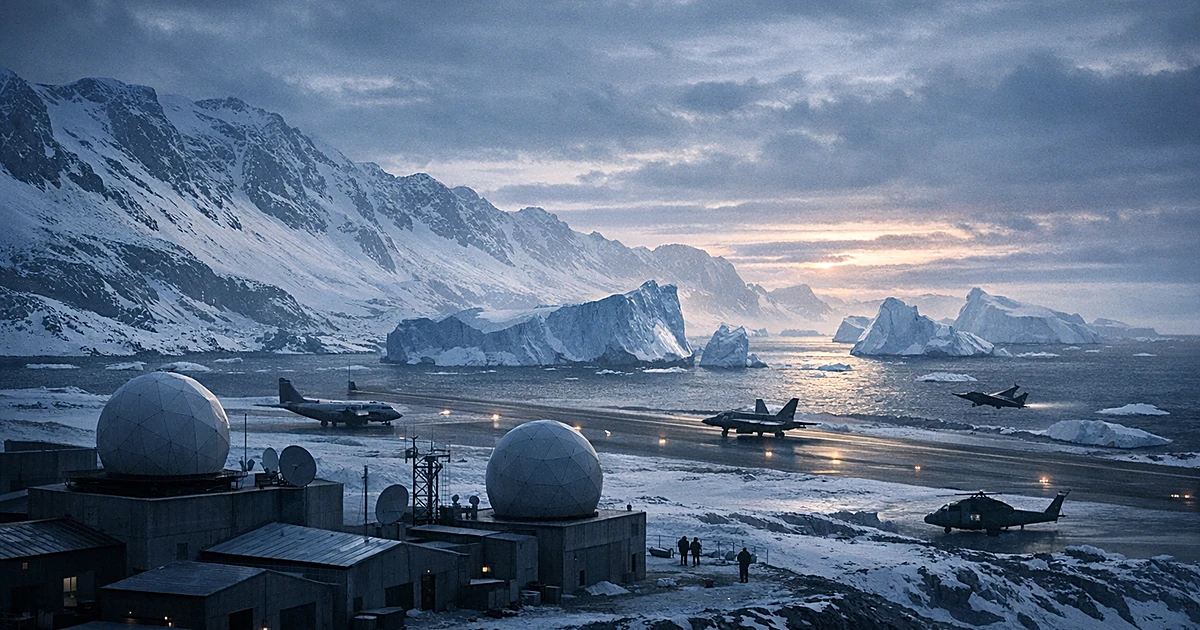
Washington plans to immediately begin building a large military presence on the island. Reports indicate three new military bases are planned for southern Greenland, a region that has seen almost no permanent U.S. military infrastructure since the Cold War drawdown. The expansion signals that the agreement is not merely a diplomatic document but the start of a concrete buildup.
Trump emphasized that the deal comes at "NO COST" to the U.S. government, a claim the Washington Examiner highlighted in its coverage. The financial terms have not been fully detailed, but the administration's framing positions the agreement as a security gain without a new spending line, a contrast to decades of defense commitments that carried enormous price tags for American taxpayers.
The deal also fits alongside other recent moves by the administration to assert U.S. control over strategic resources abroad, including Trump's pursuit of majority control over Venezuelan oil reserves.
Trump first floated the idea of acquiring Greenland during his first term, drawing ridicule from much of the media and the European political establishment. Denmark's then-prime minister called the notion "absurd." The press treated it as a punchline.
Seven years later, the punchline has a signature line at the United Nations. The agreement may not transfer territorial sovereignty, but it delivers the strategic substance Trump sought from the beginning: permanent basing rights, overflight access, veto authority over foreign military and investment activity, and a physical American presence that no future administration can easily undo.
Critics who dismissed the Greenland push as bluster now face a finished product. The deal still requires approval from Danish and Greenlandic lawmakers, and political resistance in both parliaments could slow ratification. But the framework is set, the terms are public, and both governments have signaled support.
While opponents have spent years questioning Trump's capacity and intentions, including baseless speculation about his fitness for office, the administration has continued to produce concrete policy outcomes.
Trump posted his announcement with characteristic directness:
"From now on, no US adversary can EVER have a base in Greenland, have a military presence in Greenland, or make sensitive investments in Greenland, without our express written approval."
The administration has paired the Greenland agreement with a broader pattern of formalizing previously discussed policy positions into binding action, moving from executive orders on immigration to permanent security arrangements abroad.
The agreement's permanence depends on legislative approval in Denmark and Greenland. Greenlandic politics have grown increasingly independence-minded in recent years, and some lawmakers may resist a deal that, while preserving formal sovereignty, effectively cedes security authority to Washington for the foreseeable future.
Danish lawmakers face their own political calculations. Rasmussen's endorsement suggests the governing coalition views the pact as preferable to the alternative, an Arctic increasingly contested by Moscow and Beijing with Copenhagen unable to defend its own territory. But parliamentary debate could surface objections over the scope of U.S. veto power and the planned base construction.
For the United States, the deal requires no Senate treaty ratification under the terms described so far, though the details of the basing agreements and any associated funding will likely draw congressional scrutiny as construction begins.
The administration has not disclosed a timeline for when the first new bases would become operational, or how many U.S. personnel would be stationed on the island. Those details will shape whether the agreement functions as a genuine deterrent or a symbolic footprint.
None of that changes the core achievement. A deal that the foreign policy establishment mocked as impossible is now on its way to a signing ceremony at the United Nations. The Arctic's most strategically important landmass will host American forces on a permanent basis, and the two nations most eager to exploit its resources, Russia and China, need Washington's permission to set foot there.
The people who laughed loudest in 2019 have the least to say now. That tends to happen when results replace speculation.