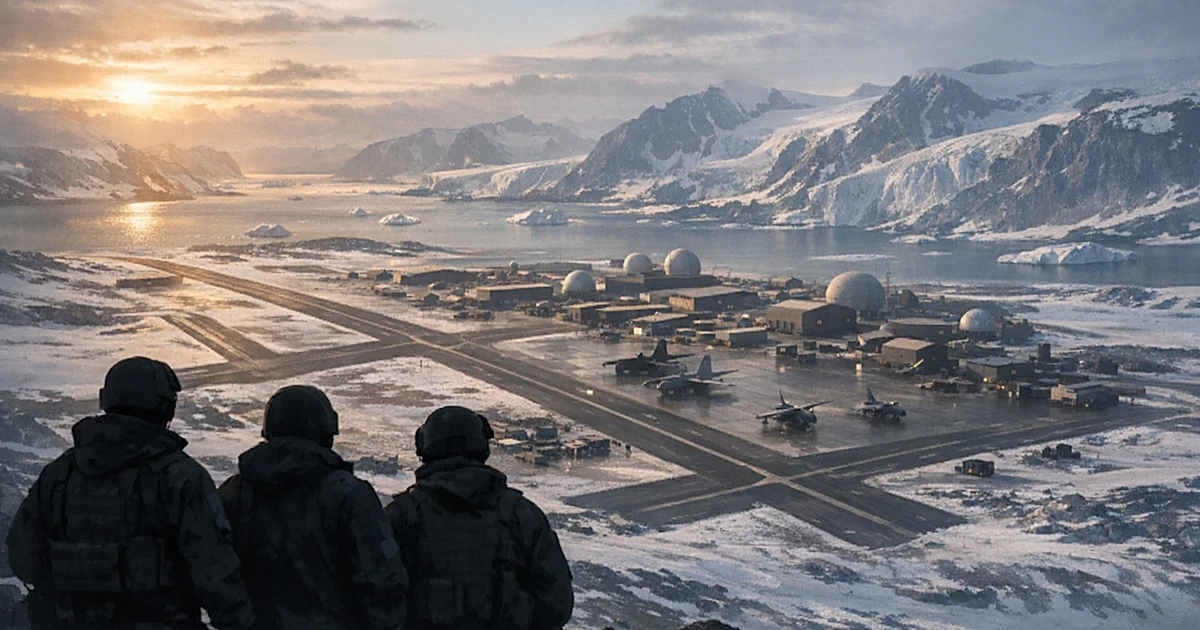
President Trump announced a sweeping agreement with Denmark and Greenland granting the United States permanent military access and basing rights on the strategically vital Arctic island, a deal his administration says locks out China and Russia at no cost to taxpayers.
The agreement, reached after months of quiet negotiations that began in February, gives the U.S. permanent access, basing, and overflight rights across Greenland. It also grants Washington the authority to build additional military installations on the island without requiring approval from Copenhagen or Greenland's self-governing authorities, only consultation. Secretary of State Marco Rubio, who led the negotiations alongside White House advisor Stephen Miller and officials from the State Department and National Security Council, told Fox News Digital the deal carries no expiration date and is designed to survive even if Greenland eventually becomes an independent nation.
Trump posted on Truth Social Friday to claim the achievement personally:
"For over 100 years, Presidents have known the strategic importance of Greenland, but NONE of them were able to do anything about it. I am proud to be the President that permanently and conclusively addressed this very important situation. This is an 'Infinite Life' Agreement, there is no end!"
He followed up by announcing that the U.S. would "immediately begin the process of developing a large Military presence in the appropriate part of Greenland" and pledged to "work with the people of Greenland in its development and construction."
Beyond expanding U.S. access, the agreement explicitly bars China, Russia, and all other non-NATO countries from establishing military bases or maintaining troops on the island. It also restricts adversary nations from investing in sensitive sectors that could threaten American national security, including telecommunications infrastructure, undersea cables, ports, and critical minerals. Only the United States and its allies may make such investments under the new terms.
Rubio framed the deal as a direct response to growing Arctic threats. Russia and China have both expanded their presence and military capabilities in the region in recent years, and the administration drew a parallel to the Panama Canal, where Chinese commercial interests raised security alarms in Washington.
Rubio told Fox News Digital:
"Thanks to President Trump's vision and leadership, this historic agreement permanently guarantees U.S. security interests in the Arctic at zero cost to the U.S. taxpayer."
He added that "Greenland will forever be part of the strategic defense area of North America and exclude any adversary from it and the surrounding area."
A senior U.S. official briefed on the deal emphasized the financial terms: "The difference here is we're not spending any money for the right" to expand the American military presence. That same official said the agreement ensures the U.S. will never face a strategic vulnerability in Greenland like the one that emerged around the Panama Canal. "We're never going to face that in Greenland as a result of this," the official said.
The agreement stops short of transferring sovereignty over Greenland to the United States, a distinction worth noting given Trump's earlier, more ambitious rhetoric about outright acquisition. Denmark retains formal control over the territory. But the practical effect of the deal is that Washington now holds permanent military authority over the island's defense posture, with the power to build bases and station forces without needing Danish or Greenlandic sign-off.
Rubio acknowledged that Denmark and Greenland came to the table partly out of self-interest. "They recognize, at the end of the day, that they have a national security concern here as well," he said. He went further: "Denmark and Greenland understand that they don't have the financial means necessary to defend Greenland if it were to come under attack or be threatened. The United States has the power to do that."
A second U.S. official described the months of negotiations as producing a result that satisfied all three parties, though neither the Danish nor Greenlandic governments had publicly commented at the time Fox News Digital published its report. Breitbart reported the deal is set to be formally signed at the United Nations General Assembly, pending parliamentary approval.
The administration also sees the expanded Greenland footprint as playing a role in Trump's planned Golden Dome missile defense system, though specific details about how Arctic installations would integrate into that system were not disclosed. The president's broader push to assert executive authority across multiple fronts has defined his second term, and the Greenland deal fits that pattern, a permanent structural change, not a temporary arrangement subject to the next administration's whims.
Trump's interest in Greenland dates back to his first term and drew widespread skepticism at the time. His second-term approach was more aggressive. Earlier in the process, he floated tariffs against NATO allies, including Denmark, as leverage. National Review reported that Trump dropped planned tariffs of 10 percent, set to rise to 25 percent, on eight NATO allies after forming a "framework of a future deal" with NATO Secretary General Mark Rutte regarding Greenland and the broader Arctic region. At Davos, Trump explicitly ruled out military force: "I don't have to use force. I don't want to use force. I won't use force."
Danish Prime Minister Mette Frederiksen had publicly pushed back against Trump's designs on the island, issuing what was described as a defiant message at the 2026 NATO Leaders Summit in Ankara, Turkey, earlier in the week. But the final agreement suggests that behind the public posturing, Copenhagen calculated that cooperation served Danish interests better than continued resistance.
The U.S. already operates Pituffik Space Base in northern Greenland under a defense agreement dating back to 1951. The new deal vastly expands on that Cold War-era arrangement, transforming a limited basing agreement into a permanent, comprehensive security framework that covers everything from troop deployments to investment screening. Just The News confirmed the deal's core terms, including permanent basing and overflight rights and the ban on Chinese and Russian military presence.
The Washington Examiner reported that Trump announced the agreement personally on Friday, describing it as giving the U.S. "permanent control over security, and all other needs, in Greenland" at "NO COST" to the government.
For all the administration's confidence, several questions remain unanswered. The full text of the agreement has not been released. It is unclear whether the deal takes the form of a treaty, which would require Senate ratification, or an executive agreement that could be finalized without congressional approval. The distinction matters: a treaty carries the force of law and is far harder for a future president to undo.
The administration's enforcement push extends well beyond foreign policy. Domestically, agencies like ICE have posted record-breaking arrest numbers as part of Trump's broader effort to translate campaign promises into durable policy outcomes.
It also remains to be seen how Greenland's self-governing authorities will respond publicly. Fox News Digital reached out to both the Danish and Greenlandic governments for comment but did not report receiving a response. Whether Greenland's parliament must separately ratify the deal, and whether domestic politics on the island could complicate implementation, is unaddressed in the current reporting.
Trump's approach to executive power has not gone unchallenged in every arena. A federal appeals court recently upheld an injunction blocking one of his executive orders on mail-in voting, a reminder that not every presidential directive survives legal scrutiny. The Greenland agreement's durability will depend in part on its legal structure, and on whether future administrations treat it as binding.
Rubio, for his part, expressed no doubt about the deal's staying power. "This deal permanently and completely addresses our national security concerns in Greenland," he said.
At his recent Mount Rushmore address, Trump framed his presidency as a turning point against foreign threats. The Greenland agreement, locking the U.S. into the Arctic and locking adversaries out, is the most concrete expression of that vision to date.
Presidents talked about Greenland's strategic value for a century. Trump got the deal. Whether it holds will depend on the fine print no one has seen yet, but for now, the Arctic map just changed.