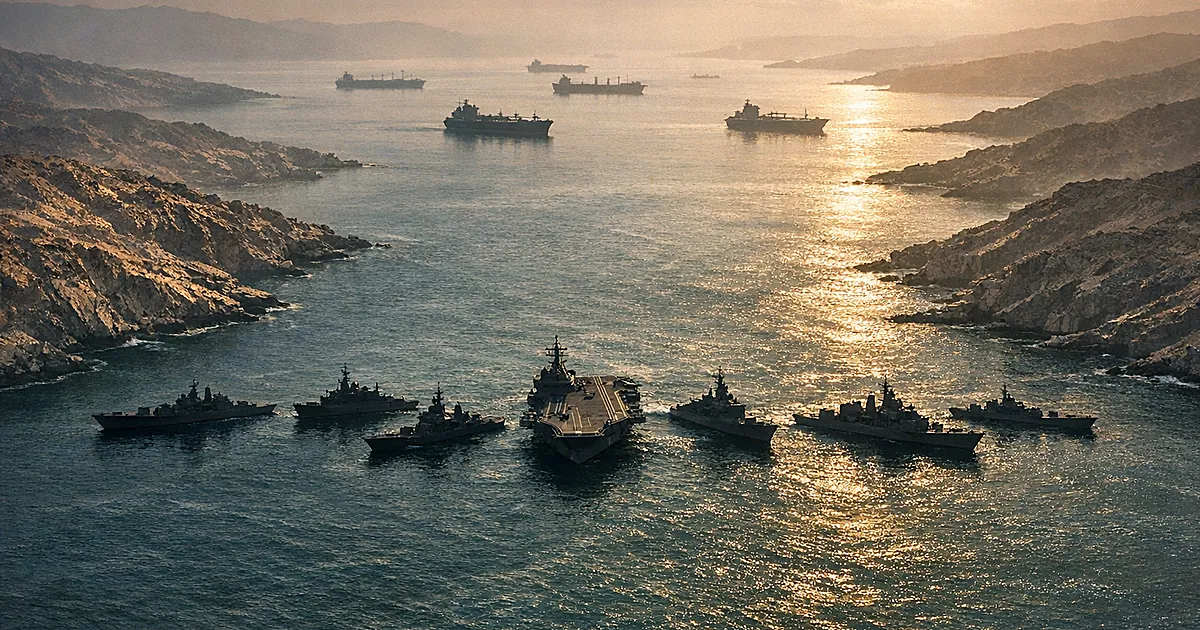
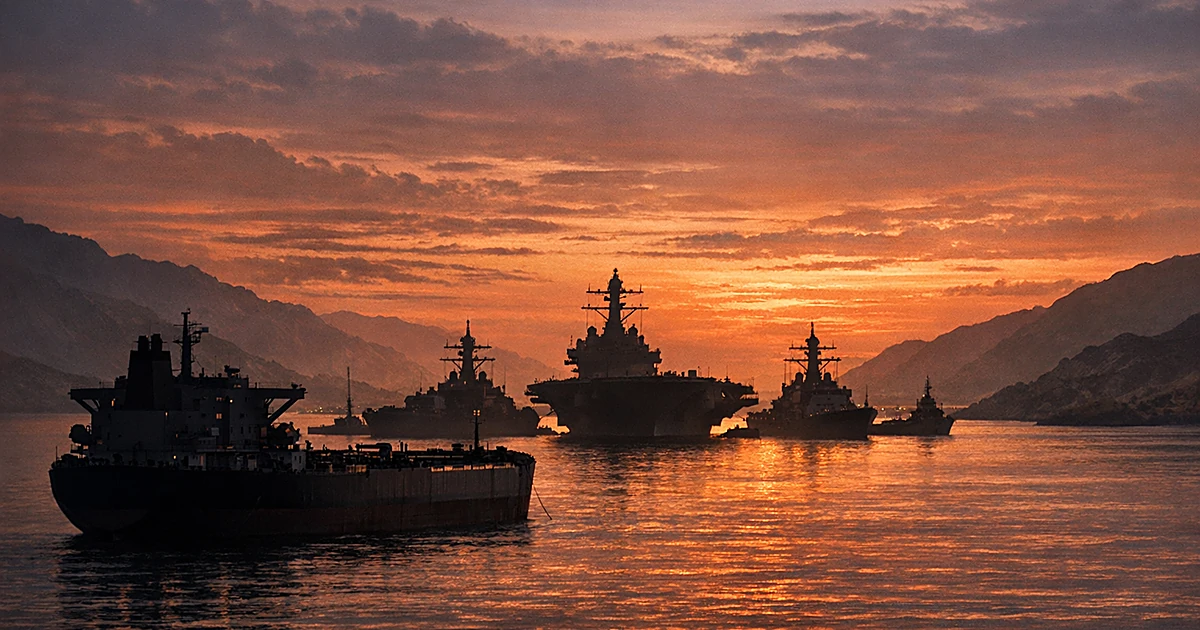
President Trump announced Sunday that the United States will impose a sweeping blockade of the Strait of Hormuz beginning at 10 a.m. EDT Monday, vowing to halt what he called Iran's "WORLD EXTORTION" of global shipping through the critical waterway. Tehran fired back almost immediately, warning that any military vessels approaching the strait would violate the existing cease-fire and draw a "strong and forceful response."
The announcement marks a dramatic escalation in the standoff between Washington and Tehran, and the most aggressive American naval posture in the Persian Gulf in decades. Trump promised to stop "any and all Ships trying to enter, or leave" the chokepoint until oil is allowed to flow freely without Iranian obstruction or tolls.
Speaking to reporters after landing at Joint Base Andrews, Trump did not sound like a president bracing for a prolonged standoff. He sounded like one who believes the regime in Tehran is running out of options.
As the New York Post reported, Trump told the press pool plainly:
"I think Iran is in very bad shape. I think they're pretty desperate."
He followed that assessment with a reference to extensive deliberations inside his administration.
"We had a meeting that lasted 21 hours. We understand the situation better than anybody, and Iran's in very bad shape."
The Strait of Hormuz is the narrow passage between the Persian Gulf and the Gulf of Oman. Roughly one-fifth of the world's petroleum passes through it on any given day. Control of the strait has been a flashpoint for decades, and Iran has repeatedly threatened to close it during past confrontations with the West.
Trump's announcement flips that script. Instead of Iran threatening to choke global energy markets, the United States is now the one imposing the chokepoint, aimed squarely at Tehran's ability to extract payments or leverage from commercial shipping.
What the president did not detail publicly is the specific military mechanism for enforcing the blockade. He did not name which naval assets would be deployed, how commercial vessels from allied nations would be handled, or how long the blockade would remain in effect. The 21-hour meeting he referenced suggests serious planning took place, but Trump did not identify the participants or the scope of the discussions.
Those gaps matter. A naval blockade of the world's most important oil chokepoint is not a tariff or an executive order. It is, by any historical standard, one of the most consequential military actions a president can order short of direct combat. House Republicans recently blocked a Democratic effort to restrict Trump's Iran war powers, a vote that now looks prescient given the scale of Sunday's announcement.
Iran's response was swift and pointed. Tehran warned that military vessels approaching the strait would violate what it called the "fragile cease-fire" and would be met with a "strong and forceful response." The source of that warning, whether it came from Iran's foreign ministry, its military command, or its supreme leader's office, was not specified in reporting.
The invocation of a cease-fire is itself significant. It confirms that some form of de-escalation agreement was in place between the two nations before Sunday's announcement. Trump's blockade order now tests whether that agreement can survive direct confrontation over the strait.
For months, critics on the left have argued that Trump's posture toward Iran risks spiraling into open conflict. Nancy Pelosi went so far as to demand Trump's Cabinet invoke the 25th Amendment over his Iran remarks, a move that gained no traction but illustrated the pitch of Democratic opposition.
What those critics have not reckoned with is the alternative. Iran has spent years leveraging its geographic position to extort tolls, threaten shipping lanes, and destabilize the region, all while enriching a regime that funds proxy militias across the Middle East. Trump's language about "WORLD EXTORTION" is blunt, but it describes a real pattern of behavior that previous administrations tolerated or tried to manage through diplomacy alone.
Trump's mention of a 21-hour meeting stands out. Presidents do not typically cite the length of their national security deliberations unless they want the public, and the adversary, to know the decision was not impulsive.
That detail serves a strategic purpose. It signals to Tehran that the blockade is not a social media bluff or a negotiating gambit. It signals to allies that the administration weighed the consequences. And it signals to domestic critics that the decision followed extensive internal debate.
Whether the meeting involved the Joint Chiefs, the National Security Council, intelligence officials, or some combination remains unstated. But the duration alone suggests a level of deliberation that contradicts the caricature of a president acting on impulse. Trump recently rebuked Tucker Carlson over nuclear-war claims tied to the Iran conflict, making clear he views the situation as serious but manageable, not apocalyptic.
The blockade is set to begin Monday morning. That leaves a narrow window for diplomacy, back-channel communication, or Iranian capitulation, none of which appeared imminent as of Trump's remarks at Joint Base Andrews.
Global energy markets will react. Allies in Europe and Asia, many of whom depend on Gulf oil transiting the strait, will have to decide quickly whether to support, oppose, or quietly accommodate the American action. And Congress will face pressure to weigh in on the legal authority underpinning a peacetime blockade of international waters.
The legal and constitutional questions are real. A blockade is traditionally considered an act of war under international law, and the War Powers Resolution gives Congress a role in authorizing sustained military operations. The Supreme Court has repeatedly sided with the administration on emergency executive actions, but a naval blockade of this magnitude would test those boundaries in ways no recent case has.
None of that changes the core calculation. Iran has exploited the strait for leverage, extracted payments from commercial traffic, and threatened global energy security, all while pursuing a nuclear program that most Western intelligence agencies regard as a threat. Trump's blockade is a bet that Tehran's position is weaker than its rhetoric suggests.
His own words at Andrews were plain: "I think they're pretty desperate."
If the blockade holds and Iran blinks, Trump will have accomplished what no president before him managed, breaking Tehran's stranglehold on the world's most important oil corridor without firing a shot. If it escalates into a military confrontation, the consequences will be measured in lives, oil prices, and the durability of American alliances.
The administration appears to believe the former is more likely than the latter. Trump's assessment that Iran is "in very bad shape" is not just rhetoric. It is the stated basis for a policy that puts American naval power directly in the path of Iranian threats.
The political risks for Trump and his team are real, and his opponents will use every available lever to challenge the decision. But the question voters will ultimately ask is simpler: Was Iran allowed to keep shaking down the world, or did someone finally call the bluff?
Monday morning at 10 a.m., we find out whether the bluff was Tehran's all along.