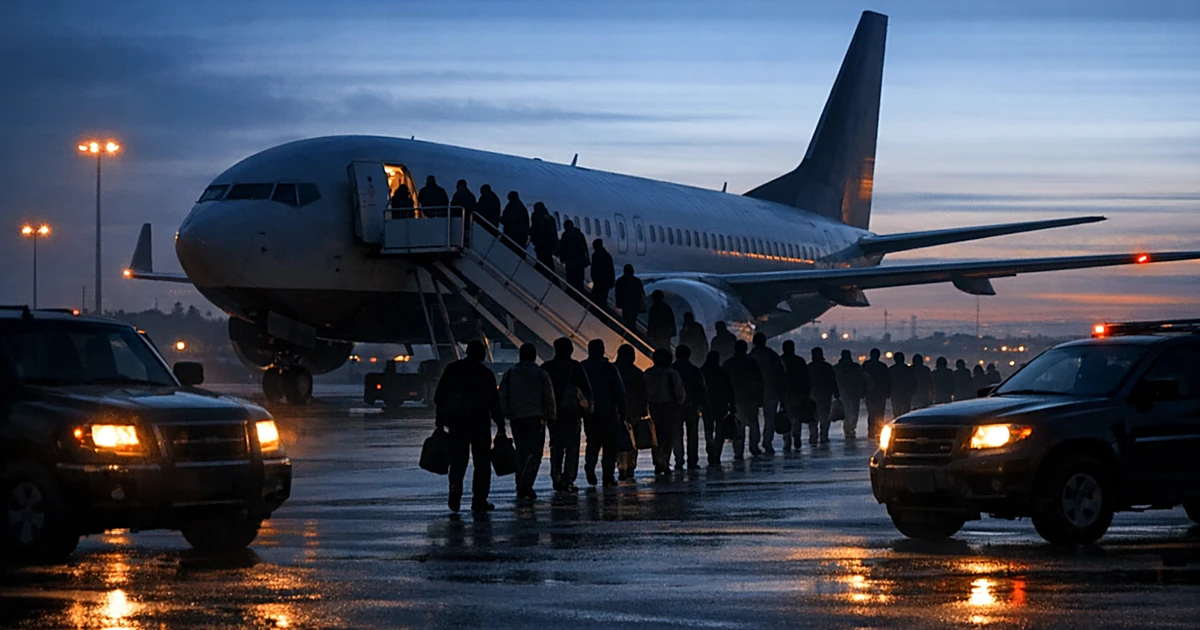
The Trump administration has sent more than 25,000 people to countries that are not their homelands since January 2025, and a federal appeals court just ruled the practice, as carried out, is illegal.
A consortium investigation led by Forbidden Stories and FRANCE 24, drawing on 26 international media outlets, mapped the scale of what the government calls "third-country removals." Using open-source flight data and information gathered by nonprofit organizations, the investigation found that at least 5,447 people of 89 nationalities were flown to foreign countries other than their own by August 31, 2026. Another roughly 20,000 were removed by land to Mexico, a country with which the United States has no official deportation agreement for third-country nationals.
In total, 28 countries across six continents had received deportees under the policy, and the administration had struck deals with seven more, bringing the number of partner nations to 35. The Department of Homeland Security framed the effort in a June 2025 statement as targeting "aliens who are so uniquely barbaric that their own countries won't take them back, including convicted murderers, child rapists and drug traffickers." But lawyers representing deportees and human rights organizations contest that description, saying many of the people removed had no criminal records at all.
Rabbiatu Kuyateh, a nurse who fled civil war in Sierra Leone in the 1990s, had lived in the United States for more than 30 years. In early July 2025, she went to a routine ICE appointment in Baltimore, Maryland. She did not leave. ICE detained her on the spot.
Four months later, she learned she would be sent to Ghana, a country more than 1,000 kilometers from Sierra Leone, where she was born.
Kuyateh told the consortium:
"Ghana? I'm not from Ghana; what am I going to do there? I only saw Ghana on the map; I don't know where that is."
She added: "I did not commit any crime; I always abided by the law." She said she had worked as a nurse and paid her taxes for decades. "I've known it as my home," she said of the United States.
Kuyateh was not alone on her deportation flight. A Senegalese man identified by the pseudonym Malick was on the same plane. Malick had come to the United States in 2023 after fleeing Senegal over safety fears. He held a work permit and had been granted "withholding of removal", a legal status that, historically, shielded people from deportation because an immigration judge determined their home country was too dangerous. Under the Trump administration's third-country removal policy, that protection no longer guaranteed a person would stay.
"I had started a new life in the United States. I felt safe," Malick said.
The broader removal effort under the Trump administration has drawn both praise from enforcement advocates and sharp criticism from legal groups. The third-country removal track raises a distinct question: when the government cannot send someone home because a judge found it too dangerous, does sending that person to a different foreign country solve the problem, or sidestep the law?
Guatemala was the second-largest destination after Mexico for third-country removals by flight, receiving nearly 3,000 people, 90 percent of them Mexican nationals. Costa Rica, Honduras, Panama, and El Salvador each took in more than 250 deportees.
Africa has become a growing piece of the operation. Thirteen African nations signed deportation deals with Washington, and 12 of those countries had already received deportees by the end of August 2026. Ghana was the largest African recipient, taking in more than 100 people from third countries. The Central African Republic, Equatorial Guinea, Sierra Leone, Eswatini, and Cameroon each received dozens.
Savi Arvey, director of policy for refugee and immigrant rights at Human Rights First, described the geographic expansion as unprecedented. During the first Trump term, she said, agreements existed with Mexico and three Central American countries. Now the reach extends far beyond.
"We're seeing that the US is going well beyond Mexico and Central America to countries in the Caribbean, countries throughout South America and countries across Africa and even in parts of Eastern Europe."
Arvey pointed to partnerships with nations she said the United States previously avoided, including "such a corrupt autocratic government like Equatorial Guinea." Her assessment was blunt: "It seems like the goal for the United States is the deal. The profile of the country, its human rights record doesn't matter at all."
The administration has also struck a deal with Guyana, which received its first transfer, six people from Cuba and Afghanistan, in early September 2026. ICE enforcement operations have expanded across multiple fronts during the same period, and the third-country flight program appears to be one of the fastest-growing tools in the agency's arsenal.
Several of the deportees profiled in the investigation held legal protections that were supposed to prevent exactly what happened to them. "Withholding of removal" and protection under the Convention Against Torture, the international agreement barring countries from sending people to places where they face persecution or torture, had historically kept people in the United States when their home countries were deemed unsafe.
The Trump administration found a workaround: send them somewhere else.
Arvey called this one of the most alarming elements of the policy:
"What's been extremely worrying is the targeting of people who've been granted withholding and removal or protection under the Convention Against Torture for third-country removals, in particular to various countries in Africa, but also to Mexico."
A Ghanaian woman identified by the pseudonym Soraya illustrates the concern. Soraya fled to the United States in 2024 because of her sexual orientation. An immigration judge granted her withholding of removal. She was then deported, not to Ghana, but to Cameroon.
"Withholding of removal, it's protection. I was thinking they were going to protect me rather than sending me to a third country that will not accept me. But they still brought me to Cameroon, an African country that doesn't accept LGBT."
Meredyth Yoon, a lawyer representing more than a dozen third-country nationals removed to African countries, said the pattern is clear: "In many cases, what we have seen is they are very much sending people back to countries that US immigration judges have established are dangerous for them."
Alma David, another American lawyer representing dozens of deportees sent to Africa, said most of her clients had no criminal record, a direct contradiction of DHS's stated rationale that the policy targets violent criminals whose home countries refuse to take them back.
A woman identified as Isatou, a Guinean national who migrated to the United States to flee a forced marriage, was removed to Ghana. From there, she was sent back to Guinea, her home country, the very place she had fled. She is now in hiding. "I don't go out anymore, I'm scared of coming across my family," she said. "They ruined my life."
Arvey raised a specific legal concern about several of the agreements: some deals explicitly describe the receiving country as a "transfer point," meaning the deportee may not stay there but could be sent onward, potentially back to the country they originally fled. The technical term is "chain refoulement," and it violates international law if the end result is a person landing in a place where they face persecution or torture.
"What's been so concerning in this case is that often there's a reference to just transit. It's very overt that the country understands that it will just serve as a transfer point. So it raises huge concerns about refoulement."
Michael Garcia Bocheneck, interim director of Human Rights Watch's U.S. program, framed the entire policy as a deliberate evasion:
"We think the government is using third-country removals to avoid the responsibilities that it has under international law not to return people to harm. (...) In many cases, it seems that the tacit assumption is that the third country will simply return them to their home country anyway. It's an indirect form of return to harm, and it's still a violation of international law."
Human Rights Watch has also documented conditions for more than 250 men held in a high-security prison in El Salvador after third-country removal. The organization described "inhumane prison conditions," "constant beatings," and "cases of sexual violence" inside the facility.
Carolyn Patty Blum, a clinical professor of law emerita at UC Berkeley, said the legal principle is straightforward: "No one should be forced to return to any country where they face a risk of persecution, human rights violations or torture." She added that "both the United States and the receiving countries violate that law by transferring people to places where they face serious risk of harm." Blum also criticized the diplomatic assurances embedded in some deals, calling them "inadequate" and noting the absence of "any methods of ongoing oversight" once a person leaves U.S. custody.
On September 18, 2026, a federal appeals court handed down a ruling that struck at the heart of the policy. The court found that removing individuals to third countries without giving them a meaningful opportunity to raise fears of torture or persecution is illegal. It rejected the Trump administration's argument that general human rights assurances from receiving countries were sufficient.
The court ruling on third-country deportations came out of a class-action case brought by the National Immigration Litigation Alliance and other groups. Trina Realmuto, the alliance's executive director, said the decision takes effect immediately: "The decision is effective now, which means DHS cannot continue to apply its existing third-country removal policy."
But DHS showed no sign of backing down. General Counsel James Percival responded that the policy would continue. "If you claim fear in your home country, DHS has the right to send you elsewhere," he said.
Realmuto anticipated the next move: "We anticipate the government will seek Supreme Court review and could seek a stay of the decision while they do so." The Supreme Court has already shown willingness to side with the administration on immigration enforcement in other recent cases, making the outcome far from certain for the challengers.
At the same time, the investigation noted that the government has grown less transparent about the program over time. Arvey said the administration was initially open about the flights but has since pulled back. "At the beginning of the administration, they were really overt about the fact they're carrying out these flights," she said. "But over the past year, the government has been very opaque about these third-country transfers."
The agreements fall into two categories. "Asylum Cooperative Agreements" include some provision for the deportee to request asylum in the receiving country. "Third-Country Removal Agreements" carry no such protections. The investigation did not identify which countries hold which type of deal, and the full terms remain undisclosed.
That distinction matters. Under the first type, a person removed from the United States could at least apply for protection in the country where they land. Under the second, they arrive with no legal pathway and no guarantee of safety, a gap that immigration enforcement debates have largely ignored.
U.S. law permits third-country removals only under limited circumstances and when proper protocols have been followed to guarantee a person's safety. The consortium's investigation raises the question of whether those protocols were followed in any meaningful way for the thousands already removed, or whether the deals were structured to avoid scrutiny rather than ensure compliance.
Enforcing immigration law is not optional, and no serious person argues otherwise. But a policy that sends people to countries they have never set foot in, strips protections that federal judges granted, and operates with increasing secrecy is not enforcement, it is evasion dressed up as toughness.