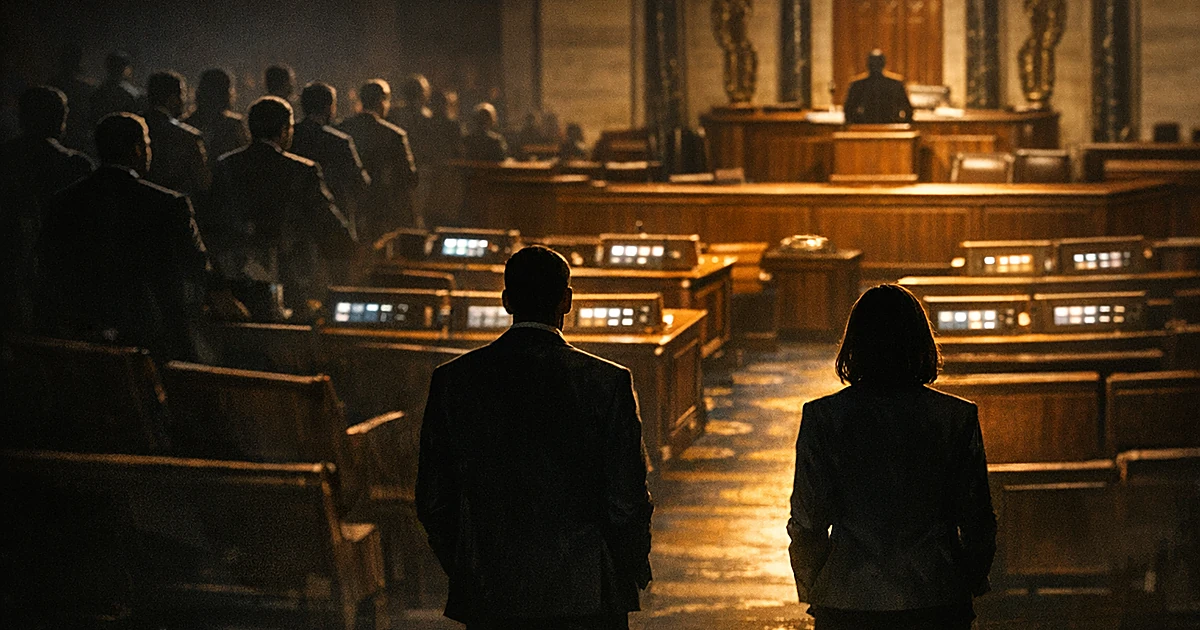
The Justice Department has dusted off a 30-year-old federal court that never heard a single case, and is now using it to remove a 47-year-old Afghan woman accused of helping her family plot an ISIS-inspired mass shooting on Election Day 2024.
Nazira Haji Zada, a lawful permanent resident from Fort Worth, Texas, appeared July 30 before Chief Judge Joan N. Ericksen of the Alien Terrorist Removal Court, a body Congress created in 1996 but that had sat empty for three decades. Her public defender, Matthew Farley, asked the judge to throw the case out. Ericksen denied the motion.
The hearing marked the first time the ATRC, a specialized tribunal designed to let the government use classified evidence to deport suspected terrorists, has ever convened to hear a case. Legal scholars had called it a "veritable zombie court." Now the zombie is awake, and Haji Zada is its first defendant.
Acting Attorney General Todd Blanche filed the removal application on July 15. AP News reported that an FBI memo states Haji Zada supported an ISIS-inspired Election Day 2024 attack plot and had her children pledge loyalty to the terrorist group. The government's case paints her as the driving force behind her family's radicalization.
Blanche did not hold back in a public statement:
"The allegations in this case show the matriarch of an ISIS-sympathizing family aiding in a plot to launch a mass casualty attack on American voters on Election Day. The Department's application in this court makes clear that terrorists have no place in the United States of America."
The DOJ alleges Haji Zada formally pledged support to ISIS, worked to indoctrinate her children with pro-ISIS ideology, concealed her actions from her husband, and signed off on selling the family home to financially support the plot. She entered the United States in 2018 as a lawful permanent resident. An ICE declaration notes she has no criminal history, a detail that underscores why the government turned to a court designed to handle cases built on classified intelligence rather than criminal convictions.
The Washington Examiner reported that Haji Zada obtained her green card through a program for Afghan allies, as her husband had worked at Bagram Air Base in support of U.S. forces. That her family benefited from a program meant to reward cooperation with the American military, while she allegedly pledged allegiance to the enemy, adds a bitter dimension to the case.
Haji Zada's son, Abdullah Haji Zada, and her son-in-law, Nasir Ahmad Tawhedi, both pleaded guilty to charges related to the 2024 Election Day plot. The two men were arrested after purchasing firearms from an undercover FBI employee. Fox News reported that Abdullah was sentenced to 15 years in prison and that Tawhedi pleaded guilty to conspiring to provide material support to ISIS, including ordering AK-47 rifles and liquidating family assets to fund the attack.
The Trump administration has made aggressive use of existing legal tools to remove individuals it considers national security threats. The administration has removed more than 3 million illegal immigrants, and individual high-profile cases have tested the boundaries of removal authority at every level of the federal judiciary.
Haji Zada was arrested earlier in the week of July 28. She has not been charged with any crime. That distinction matters, and it is precisely why the government chose this court.
The Alien Terrorist Removal Court was established under the Antiterrorism and Effective Death Penalty Act of 1996. It authorizes the U.S. Chief Justice to appoint five federal district judges to a panel that can order the removal of a non-citizen identified as a terrorist, using classified evidence the government does not have to reveal publicly.
The standard of proof is preponderance of the evidence, meaning the government must show it is more likely than not that the person is an alien terrorist. That is a far lower bar than the beyond-a-reasonable-doubt standard required in criminal court. Defendants are entitled to a court-appointed attorney if they cannot afford one, and they receive an unclassified summary of the evidence against them. Any removal order can be appealed to the U.S. Court of Appeals for the D.C. Circuit, the federal appeals court that handles many national-security cases.
Assistant Attorney General for National Security John A. Eisenberg framed the court's purpose in stark terms:
"The ATRC embodies the recognition that the government should not have to choose between allowing a dangerous alien to remain in the United States and disclosing sensitive classified information in a traditional removal proceeding."
A 2019 article by Aram Gavoor of George Washington University Law School and Timothy M. Belsan of the Foundation for Defense of Democracies described the ATRC as the "sole means to remove an alleged terrorist lawful permanent resident against whom the only evidence is classified." They called it a "veritable zombie court", a body that existed on paper, fully authorized by statute, but had never once been called into action.
Other contested removal cases have generated similar legal friction. Mahmoud Khalil's deportation fight reached the Supreme Court after lower courts rejected his challenge, illustrating how far defendants will push procedural objections when facing removal on national-security grounds.
Farley, Haji Zada's public defender, argued on July 30 that the entire framework violates due process. USA TODAY reported that Farley told the court the proceedings amount to a workaround:
"This is a runaround to bringing a criminal case."
He also declared the process flatly unconstitutional: "This entire scheme is in violation of due process and unconstitutional." Chief Judge Ericksen was unpersuaded. She denied the motion to dismiss and declined to release Haji Zada. Farley declined to comment when Reuters and USA TODAY reached out after the hearing.
The constitutional challenge is likely to continue. Appeals from the ATRC go directly to the D.C. Circuit, and given that no prior case law exists for this court, every procedural ruling is being written on a blank slate.
Due-process objections have become a recurring feature of the administration's most aggressive removal actions. Democrats challenged the Supreme Court after justices cleared the way for Trump to end Temporary Protected Status for Haitian nationals, arguing the process was unfair. Courts have largely sided with the administration's authority to enforce existing law.
Haji Zada's case sits in an uncomfortable gap. She has no criminal history. She has not been indicted. Yet the government says the FBI holds evidence, much of it classified, that she pledged allegiance to ISIS and actively supported a plot to massacre American voters.
The ATRC exists precisely for cases like this: situations where the evidence is real but too sensitive to air in open court. Critics will argue that a system allowing deportation based on secret evidence, with a lower burden of proof and no jury, is ripe for abuse. Defenders will note that Congress built this mechanism three decades ago, with judicial oversight and appellate review, for exactly the scenario the government now describes.
Several open questions remain. What classified evidence has the government submitted to the court? Has a formal removal hearing been scheduled? And what becomes of Haji Zada's legal status if the court ultimately orders her removed to Afghanistan, a country with no functioning relationship with the U.S. government that would facilitate an orderly transfer?
The administration has shown it will use every available tool to remove individuals it considers threats. ICE removed a convicted child sex offender after the State Department revoked a legal status that Minnesota's governor had tried to protect, another case where federal enforcement overrode state-level resistance.
Breitbart noted that Haji Zada is the mother and mother-in-law of two Afghan men already convicted in connection with the Election Day plot, reinforcing the government's portrait of a family unit organized around support for ISIS.
Congress gave the government this court 30 years ago. It took an Afghan woman with a green card, a family of convicted plotters, and a classified FBI file to finally force someone to turn the lights on. The only real question is why it sat dark for so long.