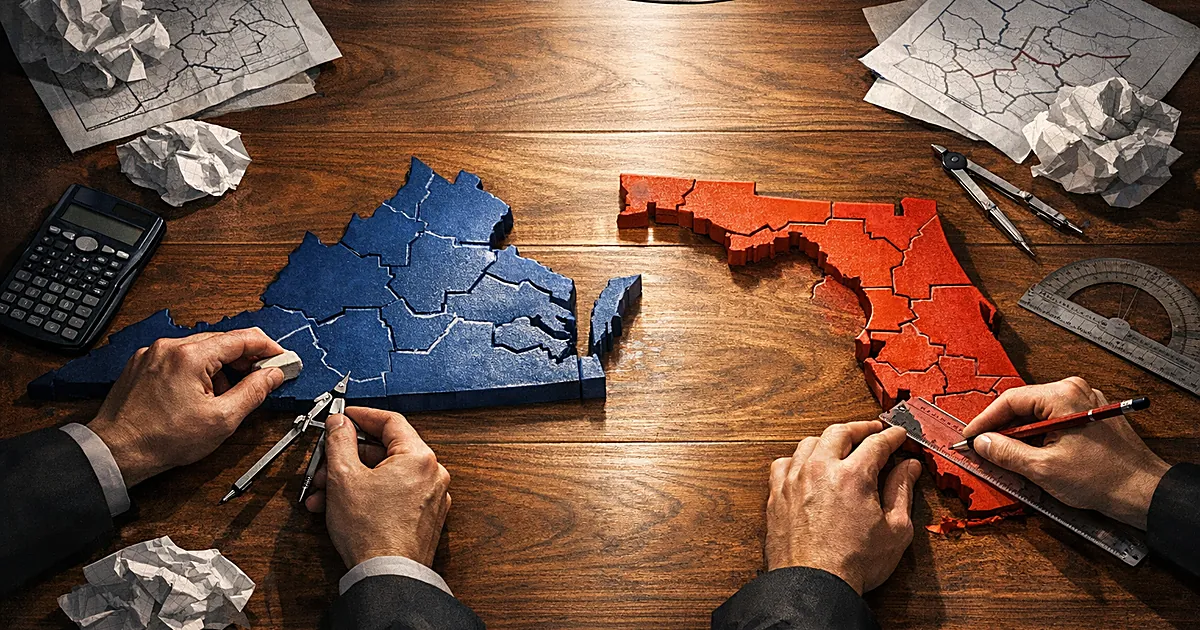
House Speaker Mike Johnson told reporters Wednesday that he wants to see Gov. Ron DeSantis push through a new congressional map for Florida, hours after Virginia voters narrowly approved a referendum that will redraw that state's districts heavily in Democrats' favor ahead of the 2026 midterm elections.
The Virginia result, called by the Associated Press at 8:49 p.m. Tuesday with just 50.3% voting "yes" and 81% of ballots counted, is expected to shift the state's congressional delegation from a 6-5 Democratic edge to a lopsided 10-1 advantage. For Republicans clinging to a razor-thin House majority, the math just got worse.
Johnson framed the Florida effort as a straightforward exercise of state authority. The Washington Examiner reported his comments Wednesday:
"Florida has the right, and they've expressed the interest of doing it there, and I think that should happen. That's my view."
DeSantis has already scheduled a special legislative session for April 28 to draw and pass a new map that would favor Republicans. The governor signaled he is acting preemptively, anticipating a forthcoming Supreme Court ruling on a section of the Voting Rights Act that bans discrimination in voting systems, a decision with the potential to reshape congressional maps nationwide.
At a news conference earlier this year, DeSantis laid out his reasoning plainly:
"I don't think it's a question of if they're going to rule. It's a question of what the scope is going to be. So, we're getting out ahead of that."
Florida is not an isolated case. Both parties have been engaged in an aggressive mid-decade redistricting push across multiple states, each trying to lock in favorable House maps before voters go to the polls in November 2026. The Associated Press reported that Texas, California, Missouri, and other states are now embroiled in legal, political, and ballot-measure fights over new congressional districts.
Democrats need to gain just three seats to take control of the House. That narrow margin has turned every map battle into a high-stakes contest. Nationally, redistricting efforts from both parties are poised to net Democrats 10 new seats and Republicans nine, a gap that could prove decisive in a closely divided chamber.
In Missouri, Republicans passed a new map aimed at delivering seven of the state's eight House seats to the GOP, while opponents there are pursuing referendums and lawsuits. The pattern is the same everywhere: one side draws, the other side sues or counter-draws.
Johnson, who has faced criticism from within his own caucus on other legislative fights, is betting that a Florida redraw can offset Democratic gains elsewhere. Republicans currently hold 20 of Florida's 28 congressional seats, a strong position, but one the party sees room to strengthen.
House Minority Leader Hakeem Jeffries wasted no time taking a victory lap after the Virginia results came in. At a Wednesday morning press conference, the New York Democrat cast the redistricting fight as a national battle against what he called Republican gerrymandering.
Jeffries said Democrats would, in his words:
"Not let Donald Trump rig the midterm elections by gerrymandering maps all across the country without a forceful Democratic response. That is what you saw in Virginia. That is what you will see in Florida, and that is what has taken place all across the country."
He added a taunt aimed at Republicans:
"These Republican extremists thought that we were going to step back. They had us confused. We were never going to step back."
The rhetoric is worth examining against the facts. Democrats pushed the Virginia referendum themselves, a mid-decade redraw designed to turn a competitive 6-5 delegation into a 10-1 rout. Calling that a "forceful response" to gerrymandering requires a generous definition of the term. When your side draws a map that converts a one-seat edge into a nine-seat edge, you are not fighting gerrymandering. You are practicing it.
The Florida push faces a complication that Virginia's did not. Florida's constitution explicitly bars the drawing of districts with the intent to favor or disfavor a political party. That provision, adopted by voters in 2010, has been used in past court challenges to strike down maps deemed partisan.
Newsmax reported that the Florida redistricting effort faces both legal and political obstacles under those anti-gerrymandering rules. DeSantis and Republican legislators will need to craft a map that can survive judicial scrutiny, no small task given the constitutional language.
Johnson told reporters he was not worried that the redistricting push could backfire on Republicans. That confidence may be tested quickly. Any new map passed in the April 28 special session will almost certainly face immediate legal challenge, and the timeline to resolve litigation before the 2026 cycle is tight.
The pending Supreme Court case adds another layer of uncertainty. If the Court narrows protections under the Voting Rights Act, it could open the door to more aggressive map-drawing in multiple states. If it doesn't, DeSantis's preemptive move may face stiffer headwinds than expected.
For Johnson, the Florida map is not an abstract governance question. It is a survival calculation. The Speaker manages a historically slim majority, and his leadership has been defined by high-stakes directives issued under intense pressure from within and without.
Every seat matters. The Virginia result alone could cost Republicans four net seats if the projected 10-1 Democratic map holds. Florida, with its 28-seat delegation and current 20-8 Republican advantage, represents the biggest single-state opportunity for the GOP to claw back ground.
But the map-drawing arms race also carries risks. If voters in competitive districts see mid-decade redistricting as a cynical power grab, by either party, the backlash could erase whatever gains the new lines were designed to deliver. Johnson's public endorsement of the Florida effort ties his credibility to its outcome.
Jeffries, for his part, has been eager to frame every Republican move as an extremist overreach. He has clashed repeatedly with Johnson on everything from homeland security funding to immigration enforcement. The redistricting fight gives him another talking point, but his own party's record on map manipulation in Virginia, New York, and elsewhere makes the moral high ground a crowded perch.
The AP's framing captured the stakes plainly: the push to redraw districts for partisan advantage "is unfolding during a time of unusual political balance in Congress." That balance means neither side can afford to unilaterally disarm, but it also means every aggressive move invites an equally aggressive countermove.
Johnson has shown a willingness to adjust course when political realities shift, and the Virginia loss clearly sharpened his appetite for a Florida counter-stroke. Whether DeSantis can deliver a map that holds up in court, and in the court of public opinion, will determine whether the Speaker's bet pays off.
The April 28 special session in Tallahassee will be the first concrete test. Florida legislators will need to produce a map, pass it, and prepare to defend it in court, all while navigating a state constitution that was written specifically to prevent the kind of partisan line-drawing both parties are now racing to execute.
The Supreme Court's pending ruling on the Voting Rights Act could land at any point, reshaping the legal terrain under everyone's feet. And in states like Texas, California, and Missouri, parallel fights will continue to churn.
Democrats drew first in Virginia and won by half a percentage point. Republicans are drawing next in Florida with a bigger delegation and higher stakes. The rules of the game haven't changed, but neither side is pretending anymore that the game is about fairness.
When both parties gerrymander openly and accuse only the other side of doing it, voters are left with a simple choice: judge them by what they do, not what they say. On that score, at least, the record is bipartisan.