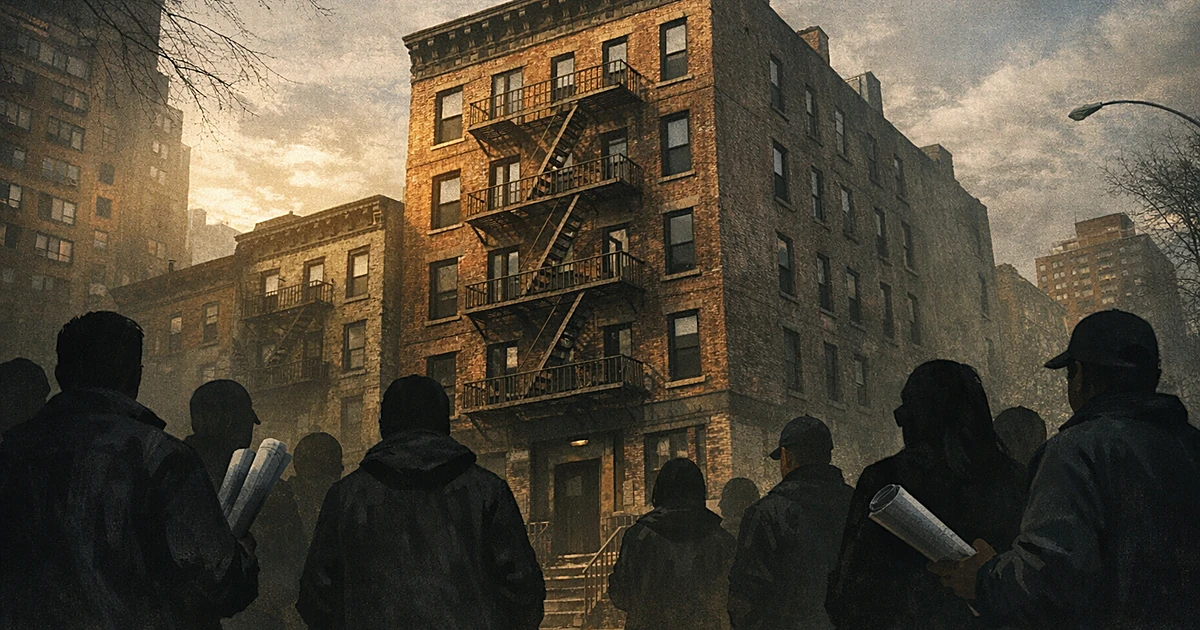
The same East Village voters who handed Mayor Zohran Mamdani a landslide victory are now hauling his administration into court, filing suit in Manhattan Supreme Court to stop him from converting a building on their block into New York City's main homeless intake center for adult men.
A group of residents and the Village Organization for the Integrity of Community Engagement, known as VOICE, filed the lawsuit Monday. They want to block the city from turning 8 East 3rd Street into a citywide intake facility. A state judge granted a temporary restraining order Wednesday, freezing the plan days before the city's target opening date of May 1.
Both sides return to court May 7. But the political damage is already done. The neighborhood that gave Mamdani 70.1 percent of the vote in Election District 45, compared to just 26 percent for independent candidate Andrew Cuomo, is now the face of resistance to one of his signature moves on homelessness.
The suit, as the New York Post reported, argues the city improperly declared an emergency, failed to conduct a required Fair Share analysis, and skipped the legal procedures that must precede a decision to site a facility of this scale. The lawsuit states:
"It challenges only the City's hastily made and legally invalid decision to locate a new citywide homeless adult male intake center at 8 East 3rd Street without following any of the legal requirements that must precede such a significant and consequential decision."
At the heart of the legal challenge is a 2022 emergency declaration originally tied to the asylum-seeker crisis. The residents allege Mamdani's administration invoked that declaration to bypass required environmental reviews and community input, repurposing a crisis-era shortcut for an entirely different policy goal.
Mamdani's office framed the project as a necessary replacement for the deteriorating Bellevue Shelter on 30th Street, which housed roughly 250 people. The mayor has said he intends to close the Bellevue facility by the end of the month. In his own words, as the Post reported, Mamdani defended the urgency: "We received expert guidance that vacating that site was an urgent and immediate need, as opposed to a suggestion to consider in the years to come."
That may sound reasonable in a press release. It sounds different to the people who live on East 3rd Street.
The building at 8 East 3rd Street currently functions as a 175-bed transitional housing facility run by Project Renewal, according to PIX11 reporting cited by the Daily Caller. Residents are not objecting to the existence of shelters in their neighborhood. They are objecting to the scope of what the city wants to do next.
VOICE coalition member Caleb Berger told NY1 plainly:
"We are not against living with shelters. We all live in the East Village, they are part of the social fabric. What they are proposing is to move the entire intake operation, essentially the front door of the New York City, five-borough shelter system, to our narrow residential block."
That distinction matters. This is not a case of wealthy homeowners refusing any contact with the city's homeless population. These residents already live alongside a shelter. What they object to is the city funneling every single adult male seeking shelter in all five boroughs through one residential street, with no environmental review, no community input, and no public process.
The administration's pattern of governing by decree and ideological impulse rather than through lawful process is becoming a recurring theme under Mamdani.
Conservative commentators wasted no time pointing out the contradiction. Fox News reported that the East Village residents who backed Mamdani by a roughly 40-point margin are now the ones suing to stop his shelter plan. Republican Texas Sen. Ted Cruz posted a single word on X: "Oops."
Former Republican New York attorney general candidate Michael Henry was more direct. He wrote on social media:
"No one is more 'not in my backyard' than white progressives. This community voted for Mamdani in a landslide but don't want to live with the consequences."
Henry's observation is blunt, but the numbers back up the core point. Election District 45 gave Mamdani a dominant 70.1 percent. Now a coalition from that same district is asking a judge to stop him. Progressive voters love progressive policy, right up until it arrives on their block, without warning, under an emergency declaration that has nothing to do with the actual emergency being cited.
The legal question at the center of this fight deserves more attention than it will probably get. The 2022 emergency declaration was issued in response to the asylum-seeker influx. Whatever one thinks of that declaration's original merits, it was tied to a specific crisis involving a surge of migrants arriving in New York City.
Using that same declaration years later to skip environmental reviews for a homeless shelter replacement is a stretch, and the kind of executive overreach that erodes public trust in government at every level. If an administration can invoke a years-old emergency order to fast-track any project it wants, the legal requirements for community input and environmental review become meaningless.
Mamdani's broader governing approach has already drawn fire on multiple fronts. His race-based tax proposals have alarmed business leaders and taxpayers alike. His administration's habit of moving fast and bypassing normal channels may play well in progressive media. It plays less well in court.
The temporary restraining order granted Wednesday suggests at least one state judge found enough merit in the residents' claims to halt the city's plans. The May 7 hearing will determine whether that order holds.
The Bellevue Shelter on 30th Street is, by the city's own description, deteriorating. Nobody disputes that New York has a serious homelessness problem that requires real infrastructure. The question is whether the mayor can ram a citywide intake facility into a residential neighborhood without following the law, and whether the voters who put him in office are willing to accept the consequences of the policies they endorsed.
So far, the answer from East 3rd Street is no.
Mamdani has already faced resistance from major business interests over his penthouse tax proposals, and his tax-the-rich agenda has stalled in Albany. Now his own base is suing him. The coalition that elected him is fracturing not because of some right-wing pressure campaign, but because his administration treated its own supporters the way progressive governments always treat the public: as people whose input is optional.
Elections have consequences. Apparently, so does skipping the paperwork.