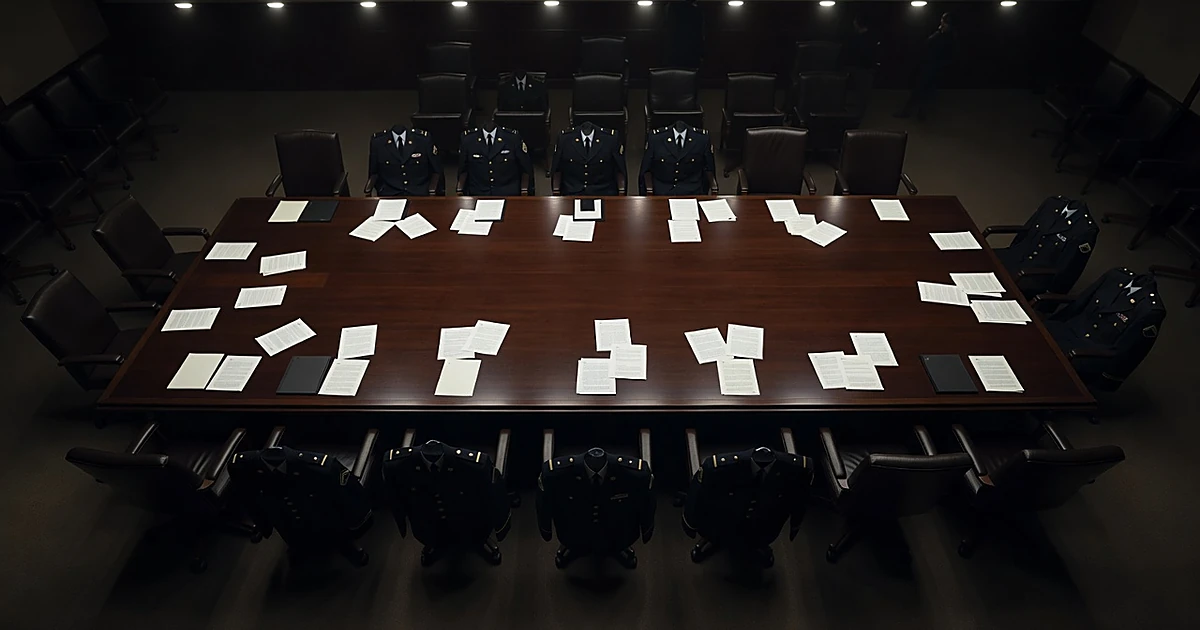
Defense Secretary Pete Hegseth’s plan to cut 20 percent of the nation’s admirals and generals drew a cool reception from key senators who said they still lacked his detailed rationale.
Hegseth confirmed the reduction Wednesday in a 52-minute speech to active-duty officers at Marine Corps Base Quantico in Virginia, framing the move as basic accountability rather than a political housecleaning. Service branches have been asked to carry out the cuts by Jan. 1 next year, with some positions downgraded instead of eliminated.
The Hill reported that defense-focused lawmakers on both sides of the aisle greeted the announcement with caution, skepticism, or outright criticism, and several Republicans said they had not been briefed on the specifics.
The proposal builds on earlier steps under Hegseth to thin senior ranks and refocus the force on warfighting over bureaucracy. It arrives as the Pentagon continues a wider personnel overhaul that has already removed more than two dozen senior officers and blocked dozens of promotions across the Army, Navy, and Air Force.
Sen. Ted Budd, R-N.C., declined to endorse the cuts when asked whether they were a good move.
Budd told reporters, “No, I certainly want to see his rationale in detail, and I don’t have that yet.”
Sen. Deb Fischer, R-Neb., kept her focus narrow. “We are focused [on] what we are doing today,” she said.
Senate Armed Services Committee Chairman Roger Wicker, R-Miss., offered no policy answer at all. Approached for comment Wednesday, he sang lines from Alfred Tennyson’s “Ulysses”: “There lies the port; the vessel puffs her sail; there gloom the dark, broad seas. My mariners, souls that have toiled, and wrought, and thought with me.”
Sen. Mike Rounds, R-S.D., said late Tuesday he had learned of the plan only through news reports and had received no Pentagon briefing. “I don’t know what his plan is,” Rounds said.
One Republican voice struck a more open tone. Sen. Rick Scott, R-Fla., a former Navy radarman and Trump ally, said he had not seen the plan but added that most large organizations grow top-heavy and that efficiency reviews are warranted so the military does not waste money.
That measured posture fits a broader pattern of Senate friction around Hegseth’s tenure, including earlier calls from some Republicans for his replacement.
Hegseth used the Quantico speech to answer critics directly. He told the officers that media outlets call his personnel moves a purge. He calls them something else.
"Now the media calls that a purge. I call it accountability and long overdue, and frankly, the bare minimum. As usual, what the media levels as an accusation, I wear as an accomplishment."
He tied the cuts to culture change. “You see, you can’t change a culture with the same people who enabled it. Personnel is policy at every single level,” Hegseth said. He also told the junior leaders that last year’s Quantico speech had not been aimed at the top brass but at “the backbone of our force, the current and future leaders on the front lines.”
Breitbart reported that Hegseth described the 20 percent reduction as a mix of firings and fewer reserved slots, and presented it as accountability for senior officers who resisted his push away from what he calls a woke, weak force.
The address continued Hegseth’s habit of speaking past the highest ranks. He has previously staged a Quantico talk aimed at junior troops rather than top brass, underscoring his preference for direct outreach to the force.
The new target doubles an earlier goal. A year after Hegseth oversaw a 10 percent reduction in general officers, he is now pressing for another deep cut in admiral and general billets.
The New York Post reported that the reductions are part of an anti-bureaucracy push meant to finish by Jan. 1 across the Air Force, Army, and Navy, and that Hegseth has already purged more than two dozen top officials while calling for “less generals, more GIs.”
Just the News noted that the 20 percent cut covers Army, Navy, Air Force, and joint-pool positions reserved for generals and admirals, that Hegseth approved the reductions earlier, and that billets set by federal law can simply remain unfilled without new nominations to Congress.
Those mechanics matter. Cutting slots and downgrading future jobs is not the same as mass firings on the spot, yet the effect on the senior bench is still large. Hegseth’s office did not respond to a request for comment from The Hill.
Personnel fights around the secretary have also reached his inner circle, with fresh attention on reported hands-on involvement by Jennifer Hegseth at the Pentagon.
Senate Armed Services ranking member Jack Reed, D-R.I., criticized the plan late Tuesday, before the formal announcement. Reed said the cuts would “add further disruption and confusion to the military forces,” that Hegseth “offered no framework for his decision,” and that the approach “seemed to be arbitrary” and would “cause harm rather than help” the military.
Sen. Elissa Slotkin, D-Mich., a former CIA analyst, labeled Hegseth’s broader personnel drive a “purge.” She said she had heard from people inside the department about low morale and about promising officers who are women or people of color fearing they will always be viewed as diversity hires no matter how well they perform. Slotkin also claimed private Republican frustration exists but rarely turns into public pushback.
Sen. Richard Blumenthal, D-Conn., called the method “very draconian” and said Hegseth had failed to come to Congress, “which he is obligated to do.” Blumenthal further charged that the secretary is “putting political loyalty above merit” and that there is “no evidence that he’s conducted any kind of systematic or intelligent or strategic oversight” of either the numbers or the individuals chosen.
Rep. Chrissy Houlahan, D-Pa., an Air Force veteran on the House Armed Services Committee, argued that shrinking general-officer posts gives the secretary more lasting sway over who rises. In a post on X she wrote that service members “have dedicated their lives to protecting our nation and we owe it to them to have a SecDef that respects their careers, honors their service and applies their expertise to the challenges facing us today.”
Separate from the billet cuts, Reuters reported that Hegseth is also ending civilian tenured faculty appointments at the service academies to refocus those schools on warfighting, and that the Quantico speech was aimed heavily at junior service members as he continues reshaping senior leadership.
Critics have tried other pressure points as well, from legal fights over Iran operations to questions about White House confidence in his team, including earlier episodes in which Hegseth rejected claims of a search to replace his deputy.
Hegseth’s case rests on a simple claim: a military that grew thick at the top cannot fix its culture with the same leadership bench that allowed mission drift. Taxpayers fund the force. Warfighters carry the risk. Senior billets exist to serve both, not to protect themselves.
Democrats counter that the process looks arbitrary, harms morale, and skirts Congress. Several Republicans answer that they are still waiting for the written rationale and the billet list. Those are fair oversight questions. They are not an argument for freezing a top-heavy structure in place.
The services now have a deadline. Jan. 1 will show whether the cuts land as disciplined streamlining or as another round of political trench warfare. Congress can demand the plan in writing. It should also remember why the plan exists: fewer layers, clearer standards, and a force built for combat rather than bureaucracy.
When leaders treat every accountability drive as a scandal, the only thing that grows is the brass.