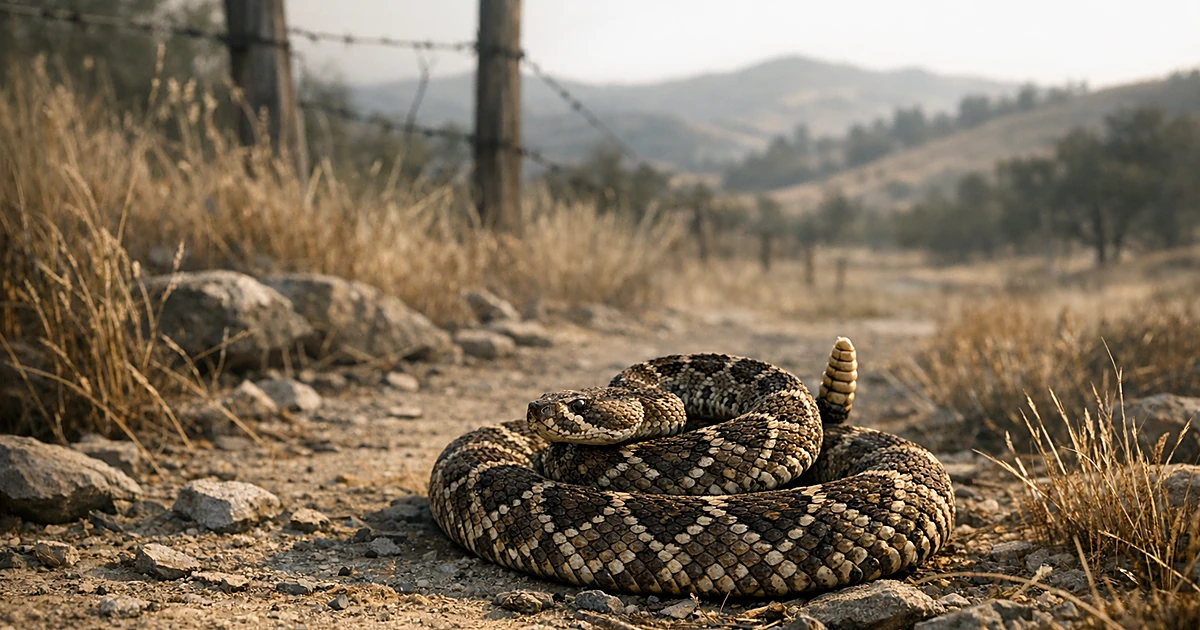
A 78-year-old woman from Redwood Valley, California, is dead after a venomous snake bit her three times while she walked through a rural area of Mendocino County on April 8. Her family rushed her to a hospital, but she was pronounced dead two days later, on April 10.
The Mendocino County Sheriff's Office confirmed the death to USA TODAY on Thursday, April 23. A forensic pathologist performed a post-mortem examination on April 15 and determined the death was accidental.
The sheriff's office offered a grim clinical summary of what took the woman's life:
"The preliminary cause of death was determined to be disseminated intravascular coagulopathy and snake envenomation from snake bites."
Disseminated intravascular coagulopathy is a severe blood-clotting disorder. In this case, it was triggered by the venom entering her system from three separate bites. The woman's name has not been released, and the sheriff's office did not identify the species of snake involved. Rattlesnakes are the only venomous snakes native to California, according to the state Department of Fish and Wildlife.
The Mendocino County death marks the third fatal snakebite incident in the state in 2026, a striking number given how rare such deaths typically are. The CDC and the Natural History Museum of Los Angeles County report that roughly 7,000 to 8,000 Americans are bitten by venomous snakes each year, but only about five to six of those incidents prove fatal nationwide.
Three of those deaths have now occurred in a single state in fewer than three months.
The first came on February 1, when 25-year-old Julian Hernandez was mountain biking with his father at the Quail Hill Trailhead in Irvine. KABC reported that Hernandez was bitten in the leg after stepping aside to let other trail users pass. He was taken to the hospital immediately but died on March 4, more than a month later. The Irvine Police Department and the Orange County Sheriff's Department told KABC that the coroner ruled his death was caused by an animal bite.
A GoFundMe page set up for Hernandez's family described the ordeal in wrenching terms:
"His whole family was there at the ICU, advocating for him every step of the way. He was progressing through recovery and his own strength for over a month. With immense sorrow and grief, Julian did not survive."
The second fatality struck on March 19, when a 46-year-old woman died from a rattlesnake bite, as reported by the Ventura County Star. The Ventura County Medical Examiner's Office determined her cause of death to be rattlesnake venom toxicity.
Confirmed deaths from wildlife encounters often draw public attention, as seen in a recent case where the University of Minnesota was fined after a wind turbine killed a bald eagle, but three fatal snakebites in one state within weeks is another matter entirely.
The fatalities are only part of the picture. Ventura County alone had received at least four reports of people bitten by rattlesnakes as of March 20, the Ventura County Star reported. Among the victims: a 14-year-old girl hospitalized for multiple days after she fell and stepped on a snake.
In Montecito, at least two snakebite-related incidents were documented on a hiking trail this month, the Palm Springs Desert Sun reported. On April 12, the Montecito Fire Protection District responded to a report of a woman bitten by a rattlesnake on the Buena Vista Trail. Authorities said she was about three-quarters of a mile up the trail when the snake struck her ankle.
These are not freak events happening in remote wilderness. They are occurring on popular trails and in areas where Californians walk, bike, and hike regularly.
Rattlesnake season in California typically runs from April through October, according to Cal Poly biological sciences professor Emily Taylor. But Brian Stark, administrator at the Conejo Open Space Conservation Agency, said recent hot temperatures have made rattlesnakes more active than usual for this time of year. A record-breaking heatwave hit the state in March, well before the traditional start of snake season.
That means snakes are emerging earlier, and in greater numbers, than many hikers and rural residents expect. The California Poison Control System identifies the most common rattlesnake species in the state as Mojave, Northern Pacific, red, sidewinder, speckled, and western diamondback. Nearly 50 snake species are native to California overall, including seven rattlesnake species.
Their range covers much of the state. Mojave rattlesnakes inhabit the Mojave Desert. Northern Pacific rattlesnakes range through the Central Valley. Red rattlesnakes extend into the southwestern region and the Baja Peninsula. Sidewinder, speckled, and western diamondback rattlesnakes occupy the southeastern deserts.
Even for those who survive a venomous snakebite, the consequences can be severe. The CDC has been direct on this point:
"Although most people do not die from snake bites, there can be lasting effects."
The agency estimates that 10 to 44 percent of rattlesnake bite victims suffer lasting injuries, including the loss of a finger or permanent loss of function in a limb. The CDC stresses the importance of reaching a hospital quickly to receive antivenom, if needed, and "stop irreversible damage."
In the Mendocino County case, the woman's family transported her to the hospital themselves. The sheriff's office did not say how much time elapsed between the bites and her arrival at the emergency room, nor did it identify which hospital treated her. What is known is that her condition deteriorated, and she was dead within 48 hours of the encounter.
Several questions linger. The species of snake that bit the 78-year-old woman has not been confirmed. The precise rural location where the attack occurred has not been disclosed. And while the sheriff's office called the death accidental, there has been no public discussion of whether warning signs were posted in the area or whether local authorities had taken any steps to alert residents about heightened snake activity following the early heatwave.
The California Poison Control System recommends specific steps if bitten by a rattlesnake, but public awareness campaigns are only useful if they reach people before they step outside. Three Californians are now dead this year from snakebites. Dozens more have been bitten. The season is just getting started.
Nature does not negotiate. It does not care about your hiking plans or your afternoon walk. When the government that manages public lands and public safety cannot even keep pace with a predictable seasonal hazard, ordinary people pay the price, sometimes with their lives.