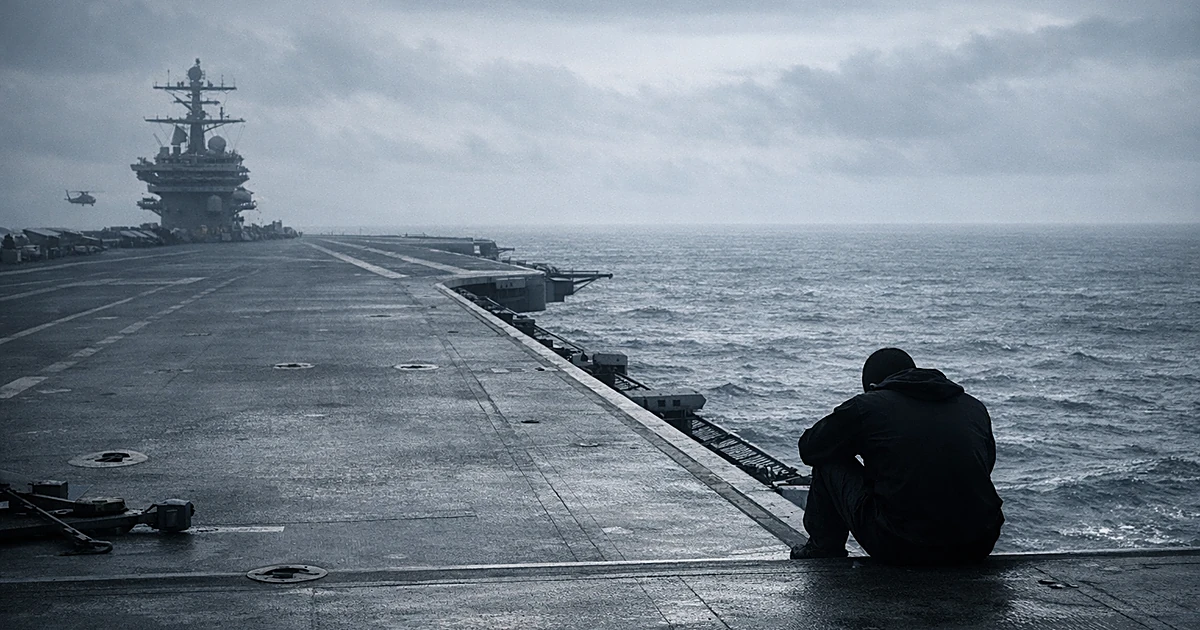
Eight sailors aboard the USS Abraham Lincoln carrier strike group attempted suicide during a grueling deployment that stretched past 280 days at sea, a crisis the administration had earlier dismissed as exaggerated reporting.
Acting Navy Secretary Hung Cao confirmed the attempts in a letter to Sen. Kirsten Gillibrand (D-NY), dated September 22, putting an official number on what had been weeks of disputed reports about deteriorating conditions aboard one of the Navy's premier warships. No sailors died by suicide during the deployment, but the confirmed count, and the details surrounding it, raises hard questions about how long the military can push service members before the human cost becomes unacceptable.
One sailor went overboard in early August and had to be rescued by helicopter. A second tried to go overboard in March but was stopped by shipmates. The remaining six attempts were confirmed without public detail on method or timing. Of the eight, only "just a few" occurred while the strike group was actively deployed in the Middle East; the rest happened while the group was stationed at port.
The Abraham Lincoln Carrier Strike Group 3 departed San Diego in November and arrived in the Middle East in January, spending more than 260 consecutive days at sea, a modern-day record for an aircraft carrier. The full deployment ran 307 days, well beyond the typical six-to-nine-month standard. The mission, originally planned for seven months, was extended and redirected to the Arabian Sea in support of combat operations against Iran under Operation Epic Fury.
That extension meant sailors who had already endured months of separation, limited privacy, and round-the-clock operations were told to keep going. Family members who spoke to the Daily Caller News Foundation and other outlets described food shortages, a decline in morale, burnout, and long waits for mental health appointments aboard the ship.
The wife of one sailor gave a window into what families were hearing. Anabelle Loma, whose husband served aboard the Lincoln, told reporters about the fear gripping crew members who were breaking down under the strain.
"He's scared. He thinks he'll get a dishonorable discharge and, just because he was burnt out, his 13-year career is ruined, just like that."
That quote, reported by Just The News, captures a dynamic the Pentagon's official statistics do not: sailors afraid that admitting they are struggling will end their careers.
On August 13, Secretary of War Pete Hegseth publicly addressed reports about the crisis aboard the Lincoln. He did not deny the reports outright, but he characterized them as distorted.
"It's completely misrepresented. Listen, we make sure that every ship, every crew, every captain has everything we can provide them at every single moment."
Four days later, on August 17, President Trump went further, referring to the situation as "fake news reporting from CNN." He also said the strike group had been deployed "not nearly long enough." The full context of those remarks was not published beyond those fragments.
Hegseth has faced mounting questions about his leadership at the Pentagon on several fronts. A bipartisan impeachment push has gained traction in the Senate, and separate reporting has raised questions about internal Pentagon dynamics under his watch.
CENTCOM Commander Admiral Brad Cooper visited the Lincoln in August to assess conditions firsthand. On August 16, Cooper posted a statement to X pushing back on the narrative of a mental health crisis.
"Of the U.S. Navy's 11 active carriers, the Lincoln currently has the lowest number of cases related to mental health."
A CENTCOM representative also told the Daily Caller News Foundation that "sailors are choosing to stay with the strike group after their deployment ends," adding that "the reports of bad mental health conditions don't match the numbers." CENTCOM cited statistics showing the Lincoln strike group had the highest sailor retention rate of all strike groups in the Navy and that, on average, other carrier strike groups reported higher numbers of suicide attempts.
The gap between CENTCOM's August reassurances and the Navy Secretary's September letter is striking. Cooper said the Lincoln had the lowest mental health caseload of any active carrier. Six weeks later, Cao's letter confirmed eight suicide attempts, a figure that, regardless of how it compares to other ships, represents eight service members in enough distress to try to end their own lives.
Whether "lowest number of cases related to mental health" refers to per-capita rates or absolute numbers remains unclear. CENTCOM did not specify. And the retention statistic, sailors choosing to stay, does not speak to the experiences of those who were struggling. Retention can coexist with crisis if the sailors in crisis are a small fraction of a large crew.
Hegseth has also rejected reports about instability in Pentagon leadership, but the confirmed suicide attempts add weight to broader concerns about whether the department is being candid about conditions facing deployed troops.
An unnamed naval officer who has deployed on multiple aircraft carriers offered a more grounded perspective to the Daily Caller News Foundation, describing the rhythm of deployment life and when sailors are most vulnerable.
"Down periods are the most horrible parts of deployment and when my sailors struggled most. Once you get into gear of your job and in the groove of things at sea, that's when morale is the highest."
That account aligns with the detail that most of the eight attempts occurred not during active Middle East operations but while the strike group was stationed at port, the "down periods" the officer described.
The crisis aboard the Lincoln did not emerge from nowhere. A 2025 study published in a military medicine journal found that naval personnel report the highest rates of serious psychological distress compared with all other branches of the U.S. Armed Forces. The study identified long separation from family, lack of privacy, and limited access to mental health care as significant contributors.
The researchers also noted a basic gap in the military's own knowledge base: "Little research has examined the experiences of service members in the U.S. Navy, and even less so the unique experiences of sailors assigned to Navy ships."
A separate 2024 study in the journal Military Psychology found that only 3.2 percent of relevant research focused solely on deployed Navy personnel. The authors wrote that understanding mental health patterns among sailors was essential "for improving well-being, readiness, and the development of effective prevention, treatment, and policy support." In other words, the Navy has known for years that it lacks the data to understand, let alone prevent, the kind of crisis that unfolded aboard the Lincoln.
The Pentagon's approach to communicating directly with junior troops has been a stated priority for Hegseth, but the Lincoln deployment suggests the gap between leadership messaging and lived conditions at sea remains wide.
Sen. Gillibrand posted to X on September 24, hours before the Daily Caller News Foundation published its report, framing the confirmed suicide attempts as a vindication of the concerns the administration had waved off.
"What Trump and Secretary Hegseth dismissed as 'fake news' turned out to be serious and deteriorating conditions for our service members. Our troops and their families make immense sacrifices every single day, yet the president dismissed them with open disrespect."
The New York Post reported that the full text of Gillibrand's statement also criticized the administration for finding "endless taxpayer dollars for bombs, ballrooms, and billionaires" while failing to care for service members.
Gillibrand's political instincts are predictable. But the underlying failure she is pointing at did not start with this administration. The 2024 and 2025 studies both predate the current deployment, and the chronic underinvestment in sailor mental health research spans multiple administrations and Congresses. The senator's own chamber has had years to fund the research and mandate the care that might have prevented what happened on the Lincoln.
Scrutiny of Pentagon leadership has intensified on multiple fronts in recent months, including questions about internal management at the department. The confirmed suicide attempts aboard the Lincoln add a human dimension to what has largely been a political fight over personnel and process.
The Daily Caller News Foundation reached out to the Department of War and the Navy for comment but did not receive an immediate response.
Several critical questions remain open. The full text of Cao's letter to Gillibrand has not been publicly released. The specific dates of the eight attempts, beyond the August overboard incident and the March intervention, are unknown. The current medical status of the sailor pulled from the water has not been disclosed. And the precise nature of the combat operations the strike group supported against Iran, beyond the designation Operation Epic Fury, has not been detailed publicly.
The Lincoln's crew endured 307 days of deployment, including at least 40 days of continuous combat operations, in service to their country. Eight of them reached a point where they tried to end their lives. The Navy confirmed it. The question now is whether anyone in Washington will treat that fact with the seriousness it deserves, not as a political weapon, and not as fake news, but as a failure that demands a fix.