Four days before a statewide referendum that could reshape the battle for the U.S. House, former President Barack Obama released a new video urging Virginians to vote "yes" on a measure that would let the Democratic-controlled legislature redraw the state's congressional map. The April 21 election has drawn more than a million early voters and tens of millions in campaign spending, and now the most prominent figure in Democratic politics is making a final push to get it across the finish line.
ABC News reported that Obama's video, shared exclusively with the network, marks his second public appearance in the "yes" campaign. He previously starred in an advertisement for the same side. In the new clip, Obama frames the vote as a chance to counteract what he calls Republican advantages elsewhere.
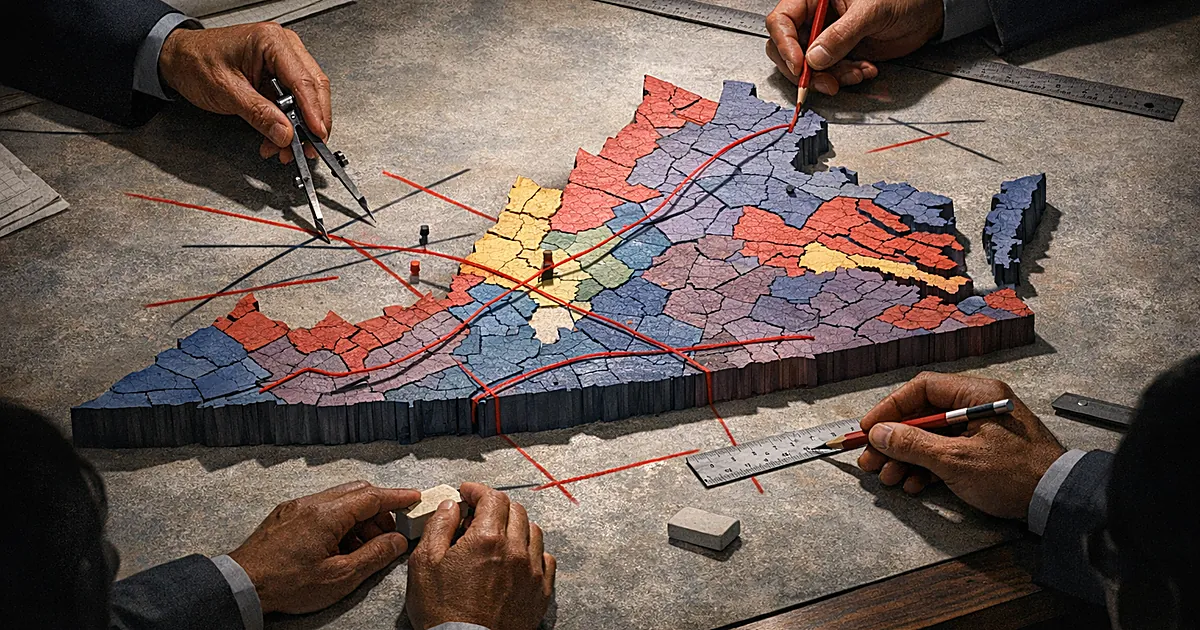
The stakes are blunt. If the referendum passes, the legislature's proposed map would reconfigure four congressional seats to favor Democrats, potentially swinging Virginia's delegation from a narrow 6, 5 Democratic edge to a lopsided 10, 1 advantage, as Fox News detailed. With Republicans holding a slim majority in the U.S. House, those four seats could be the difference between governing and watching from the minority.
Obama's language in the video leaves little ambiguity about the purpose. He told Virginians:
"By voting yes, you can push back against the Republicans trying to give themselves an unfair advantage in the midterms. By voting yes, you can take a temporary step to level the playing field. And we're counting on you."
He also cast the vote in national terms, saying it mattered "not just for the Commonwealth, but for our entire country." The framing is revealing. Obama is not arguing that Virginia's current maps are unconstitutional or that voters have been denied representation. He is arguing that Democrats need to redraw the lines because Republicans in other states have done the same.
That argument sits awkwardly alongside Obama's long public record of criticizing partisan gerrymandering. Fox News noted the apparent contradiction between his current advocacy and his past rhetoric against politicians choosing their voters. But here he is, lending his name and voice to a campaign that would temporarily suspend Virginia's bipartisan redistricting commission, a body the state created precisely to take map-drawing out of partisan hands.
Just The News reported that the referendum would suspend constitutional requirements for that bipartisan commission and hand the pen directly to state lawmakers. The proposed map would likely shift Virginia's congressional delegation from 6 Democrats and 5 Republicans to 10 Democrats and 1 Republican. That is not a tweak. It is a wholesale rearrangement of political power.
U.S. Rep. Jen Kiggans, a Republican whose district falls under the proposed redraw, told ABC News that the effort ignores the diversity of political opinion across the state. Kiggans said:
"Virginia is a very purple state, and there's a wide variety of voices in Virginia. And for one political party to come in and assume that it's their way or the highway, and to force that down Virginians' throats, this will come back to bite them."
Kiggans is right about the math. President Donald Trump received 46% of the vote in Virginia in 2024. A state where nearly half the electorate backed the Republican presidential candidate is not a 10, 1 state by any honest measure. The proposed map would effectively erase competitive districts and engineer a supermajority for one party.
Speaker of the House Mike Johnson and Rep. Ben Cline appeared at a Virginians for Fair Maps rally in Bridgewater, Virginia, on April 11, a sign that national Republican leadership views this referendum as a direct threat to the House majority. Obama's continued political activity has drawn scrutiny from multiple directions in recent months, and this latest intervention is no exception.
A Washington Post-Schar School poll conducted in late March found 52% of likely voters supported the referendum, with 47% opposed. That margin fell just outside the poll's margin of error, suggesting the outcome is far from settled.
But the money tells a different story. Campaign finance filings and an analysis by AdImpact show the "yes" side has fundraised and spent millions more on advertisements than the "no" side. Celebrities including Kerry Washington, John Legend, and Pusha T have lent their names to the effort. The imbalance in resources is stark, and it raises a fair question: if this referendum is as popular as its backers claim, why does it require such an overwhelming financial advantage to win?
J. Miles Coleman, a political analyst at the University of Virginia Center for Politics, told ABC News that the vote may ultimately come down to enthusiasm. He noted that Republicans may feel the stakes more acutely:
"For Democrats, it would be nice to have these four extra seats out of Virginia if this map gets passed. But I just think probably something driving enthusiasm on the Republican side is that, from their point of view, this vote probably seems more existential... they lost their statewide seats last year in a drubbing. They could very well stand to lose a lot of their federal representation."
Coleman's observation captures something important. For Republicans in Virginia, this is not an abstract policy debate. It is a fight for political survival. Democratic strategists have openly discussed the party's internal challenges, but the Virginia redistricting push suggests leadership has settled on a different approach: if you cannot win the argument, redraw the map.
Not every Democrat is on board. Geoff Warrington, a tech worker who identified himself as a Democrat, told ABC News outside an early polling site that he voted no. He called the effort:
"Relatively unfair to essentially have redistricting temporarily to reallocate seats to sway an election."
That is a Democrat acknowledging what Obama's video carefully avoids saying outright: this is a temporary power grab designed to sway a specific election cycle. The word "temporary" does a lot of work in the "yes" campaign's messaging. It is meant to reassure voters that the normal bipartisan process will return eventually. But once seats are won under gerrymandered lines, the incumbency advantages that follow are anything but temporary.
On the other side, Adan Hernandez, an engineer, told ABC News at a separate early voting site that he supported the referendum. His reasoning was blunt: "I mean, the Republicans have been playing dirty, so I think the Democrats are good to play dirty." At least Hernandez is honest about what this is. Obama has recently urged his party to embrace new approaches, and this redistricting fight appears to be one of them, though "leveling the playing field" sounds considerably more noble than "playing dirty."
Even as more than a million Virginians have already cast early ballots, the redistricting effort still faces a court challenge. The election was allowed to proceed, but the legal questions remain unresolved. AP News reported that the proposed map would need approval from the state Supreme Court even if voters pass the referendum, adding another layer of uncertainty.
Democrats have framed the redistricting as a "necessary counterweight" to the 2025 mid-decade redistricting that redrew nine seats nationally to favor Republicans. That is the core of their argument: Republicans did it first. But Virginia already had a bipartisan redistricting commission. The state had already chosen a different path. What Democrats are asking voters to do is abandon that path, temporarily, they promise, to give one party a commanding advantage in a single election cycle.
Breitbart noted that Obama described the plan as a temporary measure to counter Republican redistricting efforts in other states, while the legal challenges leave the plan's future uncertain. The combination of unresolved litigation, a razor-thin polling margin, and a massive spending advantage makes this one of the most consequential off-cycle elections in recent memory.
Obama's public statements have a way of generating attention, and this video is no different. But the former president's careful language about "leveling the playing field" cannot disguise what the numbers plainly show: a plan to turn a competitive state into a one-party stronghold, at least through the next election.
Virginia voters face a straightforward choice on Tuesday. They can preserve the bipartisan redistricting process their state established, or they can hand map-drawing power to a legislature controlled by one party. The "yes" campaign has more money, more celebrity endorsements, and a former president making the pitch. The "no" side has a simpler argument: the rules should not change just because one party does not like the current results.
When a former president asks voters to suspend their own state's bipartisan safeguards so his party can pick up four House seats, that is not leveling the playing field. That is tilting it.