Two one-year-old twin brothers were found dead inside their family's home in the Hyde Park neighborhood of South Los Angeles after paramedics responded to a medical emergency early Monday morning. Investigators are now examining whether a drug overdose, possibly involving fentanyl, caused the deaths of Atlas Carbajal and Sebastian Carbajal.
The Los Angeles County Medical Examiner's Office identified the boys and has performed autopsies on both children. But as of Thursday, toxicology results had not been released, and authorities had not officially confirmed the involvement of any specific substance. The cause and manner of death remain formally undetermined.
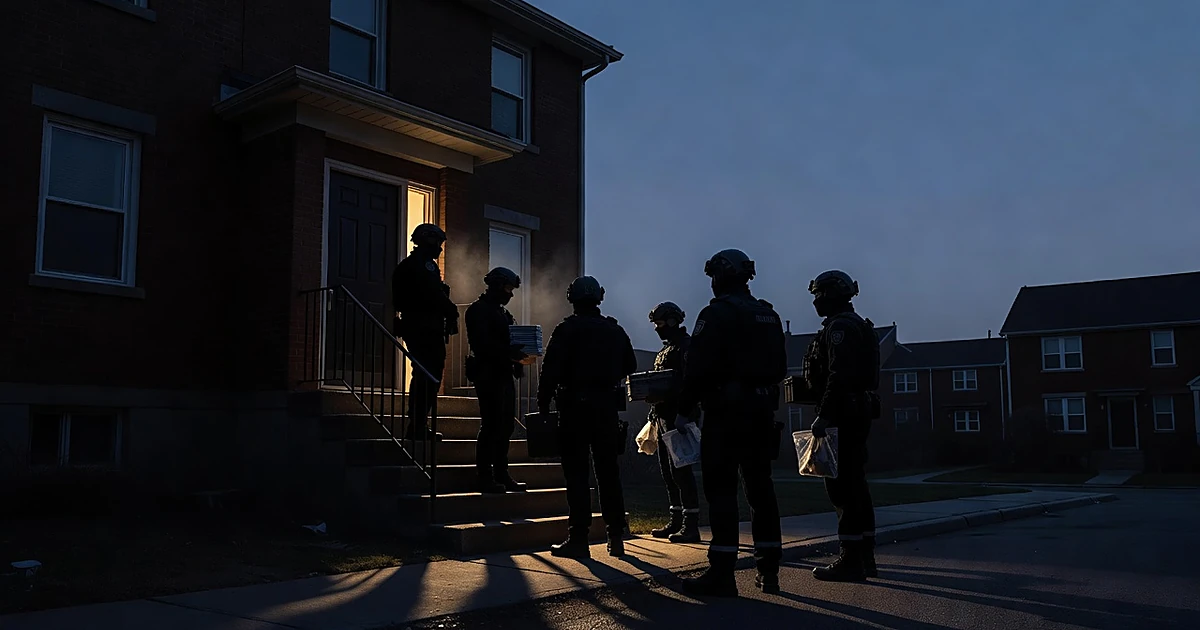
LAPD officers arrived at the residence on South Victoria Avenue near Crenshaw Boulevard at approximately 7:30 a.m. Monday, the New York Post reported. Paramedics had already reached the scene, discovered the twins, and determined that both children were dead. Detectives questioned members of the boys' family before releasing them. No arrests have been announced.
LAPD spokesman Mike Bland offered a terse public statement that raised as many questions as it answered.
"There are no outstanding suspects, or danger to the community."
Bland added that no further information would be released while both the police and Medical Examiner's investigations remain open. That language, "no outstanding suspects", leaves unclear whether anyone in the household is considered a person of interest, or whether detectives have ruled out criminal conduct entirely.
Sources familiar with the investigation indicated fentanyl may have been involved, but officials stressed that toxicology results had not yet been released. The Medical Examiner's Office is withholding autopsy findings until those results come back, a standard procedure in cases where the mechanism of death is not immediately apparent.
The gap between the preliminary suspicion and any confirmed finding is worth noting. Fentanyl is extraordinarily potent, a dose measured in micrograms can be lethal to an adult, let alone a pair of one-year-olds. If toxicology confirms exposure, the next question becomes inescapable: how did two toddlers come into contact with a synthetic opioid inside their own home?
Hyde Park sits in the heart of South Los Angeles, a community that has struggled with violent crime and drug activity for decades. The block where the Carbajal family lived, South Victoria Avenue near Crenshaw Boulevard, is a residential stretch, not a commercial corridor or known open-air drug market. That makes the circumstances all the more troubling.
The identities of the family members who were questioned have not been released. Nor has LAPD disclosed who called paramedics to the home, or what prompted the call. Those details matter. In cases involving children's deaths linked to drug exposure, the adults present in the household almost always face intense scrutiny, and, frequently, criminal charges.
Across the country, domestic tragedies involving young children have drawn renewed attention to the failures of systems meant to protect the most vulnerable. Whether this case involves neglect, recklessness, or something else entirely, the facts so far point to a household where two infants did not survive the night, and no one has been held accountable.
If fentanyl is ultimately confirmed as the cause of death, Atlas and Sebastian Carbajal would join a grim and growing roster of children killed by accidental exposure to the drug. Fentanyl-related child deaths have spiked across the United States in recent years, driven by the sheer volume of the substance flooding American communities. The drug is now the leading cause of death for Americans aged 18 to 45, and its reach extends well beyond adult users.
Children have died after touching fentanyl residue on surfaces, ingesting pills left within reach, or breathing in airborne particles in homes where the drug is used or stored. In many of those cases, the adults responsible for the children's safety faced charges ranging from child endangerment to manslaughter to murder.
Law enforcement agencies nationwide have stepped up efforts to address the broader crisis. The FBI's recent Operation Spring Cleaning, which produced more than 1,100 arrests and over 600 indictments, targeted violent crime and drug trafficking networks that fuel the supply chain for substances like fentanyl. But enforcement at the federal level does little to protect a one-year-old in a home where the drug is already present.
The policy failures that allowed fentanyl to saturate American neighborhoods, porous borders, inconsistent sentencing, revolving-door prosecution, are well documented. What is harder to quantify is the human toll on children too young to understand the danger around them.
The Carbajal case remains in its early stages, and the list of unknowns is long. Authorities have not disclosed who the boys' parents or legal guardians are. They have not said whether child protective services had any prior contact with the family. They have not indicated whether drugs or paraphernalia were found inside the home.
The decision to question and release family members, rather than detain anyone, suggests either that investigators have not yet gathered enough evidence to support charges, or that they are waiting on toxicology before making that determination. Both possibilities leave the public in the dark.
In communities already shaken by the deaths of young people under preventable circumstances, the silence from officials can feel like its own kind of failure. Families in Hyde Park deserve to know whether their neighborhood is safe, and whether the systems meant to protect children functioned at all in this case.
LAPD's assurance that there is "no danger to the community" may be technically accurate in the narrowest sense. But two dead toddlers in a family home suggest a danger that statistics and press statements do not fully capture.
Criminal investigations take time. Toxicology results take time. And the Medical Examiner's Office is right to withhold conclusions until the science is complete. But the clock is ticking on public trust. If fentanyl killed these boys, someone allowed it into their home. That person, or those persons, must be identified and held to account.
The pattern in cases like these is distressingly familiar. When families are destroyed by negligence or recklessness, the legal system eventually catches up, but only if investigators and prosecutors treat the case with the urgency it deserves. Two one-year-olds cannot advocate for themselves. They depend entirely on the adults around them and on the institutions charged with protecting them.
Atlas and Sebastian Carbajal were one year old. They had no say in where they lived, what was in their home, or who was responsible for their safety. The adults who did have a say owe the public, and those two boys, a full accounting.
When toddlers die and no one is charged, the system hasn't delivered justice. It has delivered a press release.