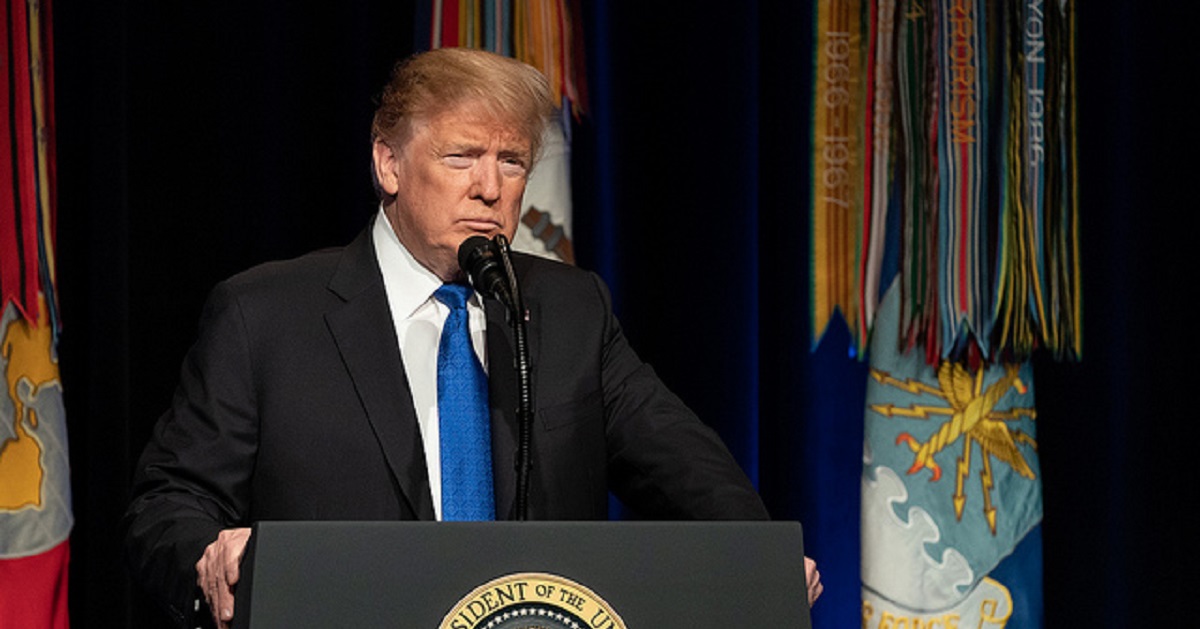
President Trump shut down a proposal from Senate Majority Leader John Thune (R-SD) to fund the Department of Homeland Security without including money for Immigration and Customs Enforcement, insisting Republicans stay in Washington and fight for the full package.
Thune shared the deal framework with Trump on Sunday, pitching a plan that would restore DHS funding while punting ICE funding to a later reconciliation bill. Trump said no.
According to Punchbowl News, citing multiple sources, the president wants Republicans to keep pressing Democrats over both DHS funding and the SAVE America Act, the GOP's voter ID and proof-of-citizenship legislation. He made his position unmistakable on Truth Social Sunday night:
"I don't think we should make any deal with the Crazy, Country Destroying, Radical Left Democrats unless, and until, they Vote with Republicans to pass 'THE SAVE AMERICA ACT.'"
That wasn't all. Trump called for bundling everything together into a single vote, eliminating the filibuster if necessary, and keeping the Senate in session through Easter recess to get it done.
The logic behind Thune's proposal was straightforward enough on paper. Fund DHS now, settle the ICE question later through reconciliation, and relieve immediate pressure on agencies like TSA whose operations have been disrupted amid the DHS funding standoff. Under reconciliation, Breitbart reported. Democrats wouldn't get some of their chief demands, including banning masks for federal agents and requiring judicial warrants for ICE operations. TSA agents would get their paychecks, and the chaos at airport security lines would end.
On paper, it sounds reasonable. In practice, it's a trap.
Splitting ICE funding from the broader DHS package gives Democrats exactly what they want: the ability to hold immigration enforcement hostage while everything else moves forward. Once the political urgency evaporates, so does the leverage to fund the agency that actually enforces immigration law. "Down the line" is where Republican priorities go to die in Washington.
Trump recognized the maneuver for what it was. In his Truth Social post, he described the arrangement as "a Five Billion Dollar cut in ICE funding, a deal which, even when disguised as something else, is unacceptable to the American people and me."
Trump didn't stop at ICE. He laid out a comprehensive set of conditions that Democrats would need to accept before he'd entertain any deal. The list included:
Then came the directive to Thune himself:
"Put it all together, and also, let Leader Thune clearly identify those few 'Republicans' that are Voting against AMERICA. They will never be elected again! In other words, lump everything together as one, and VOTE!!! Kill the Filibuster, and stay in D.C. for Easter, if necessary."
This is Trump operating in a mode Republicans have seen before: consolidating fights rather than separating them, forcing votes that put members on the record, and making the political cost of defection higher than the cost of standing firm.
According to Punchbowl News, Trump warned that he would publicly slam Senate Republicans if they left town for the upcoming recess. He also said he'd invite all GOP senators and their families for Easter dinner at the White House.
Punchbowl reported that some Republicans took the dinner invitation "as a threat, not a reward."
That distinction says more about the state of the Senate GOP conference than it does about the president. When an invitation to the White House feels like a summons, it means members know they haven't delivered. The discomfort isn't coming from Trump. It's coming from the gap between what Republican voters sent these senators to do and what they've actually accomplished.
Democrats have spent months trying to defund or hamstring ICE through every available mechanism. The DHS funding standoff isn't a budgetary disagreement. It's a proxy war over whether the federal government will enforce immigration law at all.
Every proposal to separate ICE from the rest of DHS funding serves that goal, regardless of which Republican introduces it. Thune may have presented his plan with good intentions and a reasonable timeline for reconciliation. But the structural effect is identical to what Democrats are demanding: ICE gets isolated, deprioritized, and eventually bargained away.
Trump's refusal to play along is the correct instinct. You don't negotiate away your strongest card to relieve short-term pressure. You hold the line and make the other side explain why they're willing to shut down airport security and border operations rather than fund the agency responsible for removing people who are in this country illegally.
That's the argument Republicans should be making every single day this standoff continues. Not looking for off-ramps. Not splitting the bill. Not hoping reconciliation delivers six months from now what a unified vote can deliver this week.
The Senate stays in Washington. The vote stays together. The filibuster is the only thing that should be on the chopping block.