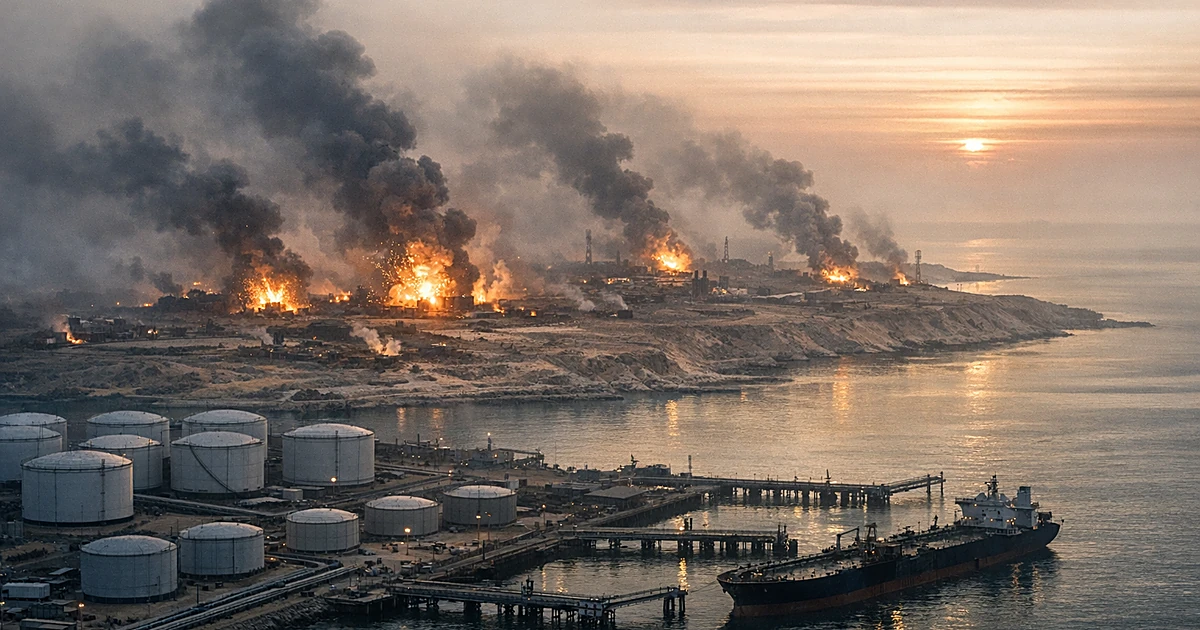
President Donald Trump announced Tuesday that the United States would halt its planned bombing campaign against Iran for two weeks, pulling back from a strike deadline of 8 p.m. eastern time after last-minute conversations with Pakistani leaders produced a fragile ceasefire framework. The pause hinges on a single, concrete demand: Iran must agree to the complete, immediate, and safe opening of the Strait of Hormuz.
Trump disclosed the decision in a Truth Social post, calling the arrangement a "double sided CEASEFIRE" and saying the administration had received a 10-point proposal from Iranian officials that he described as "a workable basis on which to negotiate." Israel, Fox News reported, has also agreed to suspend its own bombing campaign in Iran as part of the deal.
The announcement marks a dramatic shift from a posture that, just hours earlier, had the U.S. military poised to deliver what Trump himself described as "the destructive force being sent tonight to Iran." That language, and the abruptness of the reversal, underscores how close the two nations came to a far larger escalation before Pakistani Prime Minister Shehbaz Sharif and Field Marshal Asim Munir intervened.
In his Truth Social post, Trump framed the pause not as a concession but as a position of strength. He wrote:
"The reason for doing so is that we have already met and exceeded all Military objectives, and are very far along with a definitive Agreement concerning Longterm PEACE with Iran, and PEACE in the Middle East."
He added that "almost all of the various points of past contention have been agreed to between the United States and Iran," and that the two-week window would allow the agreement to be "finalized and consummated." The president's framing was unambiguous: this was a pause from a position of dominance, not retreat.
Trump has never been shy about his view of Tehran's leadership. He has previously called Iran's regime serial deceivers who have misled American presidents for decades. That history makes the two-week clock all the more significant. If Iran stalls, the president has left himself a clear on-ramp back to military action.
Iran's Supreme National Security Council issued its own statement, thanking Sharif and Munir for what it called their "tireless efforts" to end the war in the region. The council said it would cease defensive operations, but only if attacks against Iran are halted first.
On the Strait of Hormuz, Iran's language was notably cautious. The council said safe passage through the strait "will be possible via coordination with Iran's Armed Forces" and with "due consideration of technical limitations." What those technical limitations are, exactly, the statement did not say.
That caveat matters. The Strait of Hormuz is the world's most important oil chokepoint. Any ambiguity about what "coordination" and "technical limitations" mean in practice could give Tehran room to slow-walk compliance while claiming good faith. The two-week window will test whether Iran's words translate into open shipping lanes, or into diplomatic stalling.
The most striking diplomatic wrinkle is Pakistan's emergence as the broker. Trump cited conversations with both Sharif and Munir as the basis for his decision to delay the strike. Sharif, in a public statement, said the ceasefire would apply "everywhere," including Lebanon, effective immediately.
Sharif went further, inviting both delegations to Islamabad on Friday, April 10, 2026, for what he called further negotiations toward "a conclusive agreement to settle all disputes." His tone was effusive:
"Both parties have displayed remarkable wisdom and understanding and have remained constructively engaged in furthering the cause of peace and stability. We earnestly hope, that the 'Islamabad Talks' succeed in achieving sustainable peace and wish to share more good news in coming days!"
Whether those talks actually happen remains an open question. White House press secretary Karoline Leavitt told Fox News that "there are discussions about in person talks, but nothing is final until announced by the President or the White House." That careful hedge suggests the administration is not yet ready to commit to a specific venue or format, even as Sharif publicly sets a date.
The gap between Islamabad's enthusiasm and Washington's caution is worth watching. Pakistan has its own interests in positioning itself as a regional peacemaker, and Sharif's eagerness to host could outpace what the White House is prepared to deliver. Meanwhile, political reactions at home have already begun. Kamala Harris notably skipped Trump's earlier Iran address, opting instead for a prerecorded video, a choice that drew sharp criticism and raised questions about whether Democratic leaders are prepared to engage seriously with the administration's Middle East strategy.
Trump's stated condition is straightforward: the complete, immediate, and safe opening of the Strait of Hormuz. Iran's response accepts the general idea but wraps it in qualifications. The distance between "complete and immediate" and "via coordination with due consideration of technical limitations" is the distance between a deal and a delay tactic.
The 10-point proposal Iran reportedly submitted to the administration has not been made public. Trump said officials "believe it is a workable basis on which to negotiate," but neither the White House nor Fox News disclosed the substance of those ten points. Without knowing what Iran has actually offered, it is impossible to judge how close the two sides truly are.
Several other questions remain unanswered. What specific military objectives did the U.S. meet and exceed before the ceasefire? What are the exact terms of Israel's agreement to suspend its own bombing campaign? And what enforcement mechanism exists if Iran fails to open the strait as promised?
These are not trivial gaps. The broader foreign policy landscape has already tested alliances in ways that make the stakes of any Middle East deal even higher. Recent clashes over NATO's future have shown that even within the Republican coalition, there are sharp disagreements about how far the U.S. should go in reshaping its global commitments. A deal with Iran that holds would strengthen Trump's hand considerably. A deal that collapses would hand his critics fresh ammunition.
The two-week ceasefire window is, by design, short. Trump has structured it so that the pressure stays on Tehran. If Iran opens the strait, allows verifiable passage, and shows up in Islamabad ready to finalize terms, the president can claim a historic diplomatic achievement. If Iran hedges, delays, or exploits the "technical limitations" language to restrict shipping, Trump has already laid the rhetorical groundwork to resume strikes.
Trump closed his Truth Social post with a note of ceremony, writing:
"On behalf of the United States of America, as President, and also representing the Countries of the Middle East, it is an Honor to have this Longterm problem close to resolution."
That is a bold claim. Iran has been a destabilizing force in the Middle East for decades, and no American president, from either party, has managed to produce a durable agreement that changes Tehran's behavior. Trump's willingness to bring the country to the brink of a full-scale bombing campaign and then pivot to diplomacy is either a masterstroke of leverage or a gamble that Iran will exploit. The next two weeks will tell.
The security environment around these decisions is itself a reminder of the pressure this president operates under. Just recently, the Secret Service investigated gunfire near the White House while Trump was inside, a stark illustration that the commander-in-chief faces risks at home even as he manages a potential war abroad.
Diplomacy built on deadlines only works if the deadline means something. Iran has spent decades running out the clock on American presidents. This one has two weeks to prove he's different.