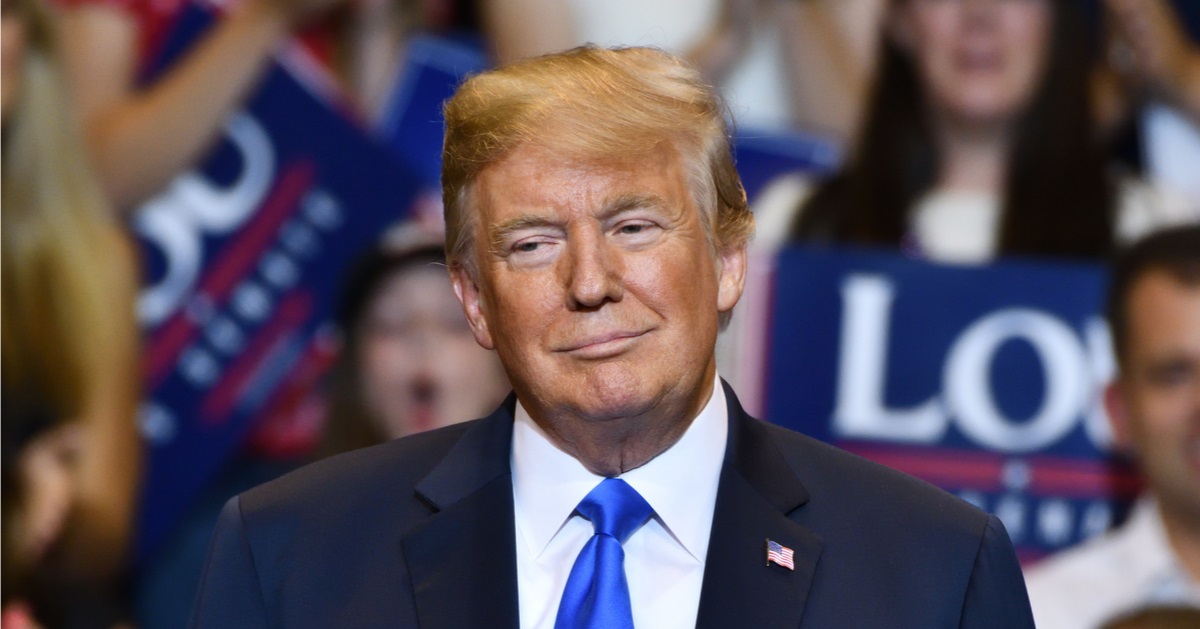
President Trump declared Saturday that Iran wants to negotiate a ceasefire, but he's not biting. Not yet.
In a nearly 30-minute telephone interview with NBC News, Trump laid out his position plainly: Iran is feeling the pressure, but the deal on the table doesn't meet his standards. He declined to specify what terms he's seeking.
"Iran wants to make a deal, and I don't want to make it because the terms aren't good enough yet."
That single sentence captures the posture of the entire operation. Two weeks into a joint U.S.-Israeli military campaign against Iran, the administration is negotiating from a position of overwhelming force, and it intends to stay there until the terms reflect it.
The facts on the ground back up the confidence. U.S. Central Command announced Saturday morning that it had conducted precision strikes on 90 military targets while preserving Iran's oil infrastructure. Trump confirmed strikes on Kharg Island, Iran's critical oil export hub, though he noted the deliberate restraint around energy infrastructure, as NBC News reports.
"We totally demolished Kharg Island, but we may hit it a few more times just for fun."
Behind the bravado is a calculated strategy. Trump explained that he spared Iran's energy lines because rebuilding them "would take years." The goal isn't to destroy Iran's economy permanently. It's to destroy Iran's capacity to project military power.
And on that front, the progress is striking. Trump told NBC that U.S. forces have knocked out most of Iran's missiles, most of its drones, and most of its manufacturing capacity for both. He said that within two days, those capabilities would be "totally decimated."
"The only power they have, and it's a power that can be closed off relatively quickly, is the power of dropping a mine or shooting a relatively short-range missile. But when we get finished with the shoreline, they're not going to have that power either."
The message to Tehran could not be clearer: every day you wait, you have less to bargain with.
One of the most significant developments from the interview was Trump's plan to internationalize the security of the Strait of Hormuz. He posted on Truth Social Saturday morning that multiple countries would be sending warships to keep the strait open.
"Many Countries, especially those who are affected by Iran's attempted closure of the Hormuz Strait, will be sending War Ships, in conjunction with the United States of America, to keep the Strait open and safe."
He specifically called on China, France, Japan, South Korea, and the UK to contribute, and said the U.S. would be "sweeping the strait very strongly." When pressed on which countries had already committed, Trump declined to name them but described their response as "very solid." He said the nations involved "think it's a great idea."
This is exactly the kind of burden-sharing that American foreign policy has needed for decades. The Strait of Hormuz isn't an American waterway. It's a chokepoint for global energy, and the nations that depend on it should bear the cost of keeping it open. Trump is forcing that conversation in real time, under live-fire conditions.
The stakes are not abstract. According to UAE data, 1,475 unmanned aerial vehicles had been fired at the country as of March 10. Iran's campaign of regional intimidation has hit real targets in real countries, and the coalition forming around the Strait reflects the reality that Iran's "thuggery," as Trump called it, affects far more than just the United States.
Perhaps the most revealing exchange in the interview concerned Mojtaba Khamenei, Iran's newly named supreme leader. Khamenei was elevated earlier this week after U.S. and Israeli strikes killed his father, Ayatollah Ali Khamenei. But the new leader's first public statement was conspicuously delivered in writing, not on camera.
Defense Secretary Pete Hegseth addressed this on Friday with characteristic directness:
"Iran has plenty of cameras and plenty of voice recorders. Why a written statement? I think you know why. His father: dead; he's scared, he's injured, he's on the run, and he lacks legitimacy."
Hegseth described Mojtaba Khamenei as "wounded and likely disfigured" and called his statement "a weak one." Trump went further, saying he's "hearing he's not alive" but acknowledged it was "a rumor." Then he added a line that doubles as both diplomacy and a threat:
"I'm hearing he's not alive, and if he is, he should do something very smart for his country, and that's surrender."
Trump also mentioned that there are people "living that would be great leaders for the future of the country," but declined to identify them, saying he didn't want to "put them in jeopardy." The implication is unmistakable: the U.S. has a vision for a post-theocratic Iran, and it involves people who already exist inside or near the regime's orbit.
None of this comes without a price. Thirteen active U.S. service personnel have died since the conflict began, including six crew members killed Friday when their military refueling plane crashed in Iraq. Trump said of the troops involved that they "have been terrific" but that "they got shot at unnecessarily."
Iraqi officials reported Saturday that an Iranian strike hit a helipad inside a U.S. Embassy compound in Baghdad. The conflict is not one-sided, and the administration isn't pretending otherwise.
There is also the question of gas prices. On March 1, the day after the U.S. and Israel began operations, gas averaged $2.94 a gallon nationally. By Saturday, it had risen to $3.66. Trump, who hammered Biden over gas prices throughout 2024, dismissed concerns.
"I think they'll go lower than they were before, and I had them at record lows."
He pointed to global oil supply as a reason for optimism, saying there's "so much oil, gas" available but that "it's being clogged up a little bit. It'll be unclogged very soon." He also referenced a decision to temporarily lift some sanctions on Russian oil, a move clearly designed to stabilize global markets during the conflict.
In one of the more unexpected turns in the interview, Trump addressed Ukrainian President Zelenskyy's offer to help U.S. forces intercept Iranian drones. Zelenskyy posted on X Friday that Ukraine had already sent expert teams to three countries in the Middle East to share drone interception expertise.
Trump was unimpressed.
"We don't need help. Last person we need help from is Zelenskyy."
He then pivoted to the broader conflict between Russia and Ukraine, saying he was "surprised that Zelenskyy doesn't want to make a deal" and that "Zelenskyy is far more difficult to make a deal with" than Putin. An unnamed Iranian politician called Ukraine a "legitimate and lawful target," a statement that underscores how tangled these overlapping conflicts have become.
Trump acknowledged reports that Russia may be sharing intelligence with Iran but was measured in his response, saying, "Russia is perhaps giving information, perhaps they're not." He noted that the U.S. is "giving a little information to Ukraine" while trying to broker peace between the two nations.
The geopolitical web is thick: the U.S. is striking Iran, coordinating with Israel, easing sanctions on Russia to manage oil prices, and fending off Ukrainian attempts to insert itself into the Middle East theater. It's a lot of spinning plates. But the through line is consistent: Trump is managing each relationship on American terms, not getting pulled into anyone else's preferred framing.
Trump said the conflict is "way ahead of the timetable," faster than the month or longer he had initially suggested it might take. He described Iran's remaining military capability in terms that suggest the campaign's kinetic phase is nearing its conclusion. There is, he said, "practically nothing left to target."
But the military campaign was never the hard part. The hard part is what comes after: the deal, the diplomatic architecture, the question of who governs Iran and under what constraints. Trump made clear Saturday that he's in no rush.
"The only thing I want to do is make sure that Iran can never be the bully of the Middle East again."
That's not a ceasefire condition. That's a strategic objective. And it requires patience, leverage, and a willingness to walk away from a bad deal. Saturday's interview was Trump telling the world he has all three.