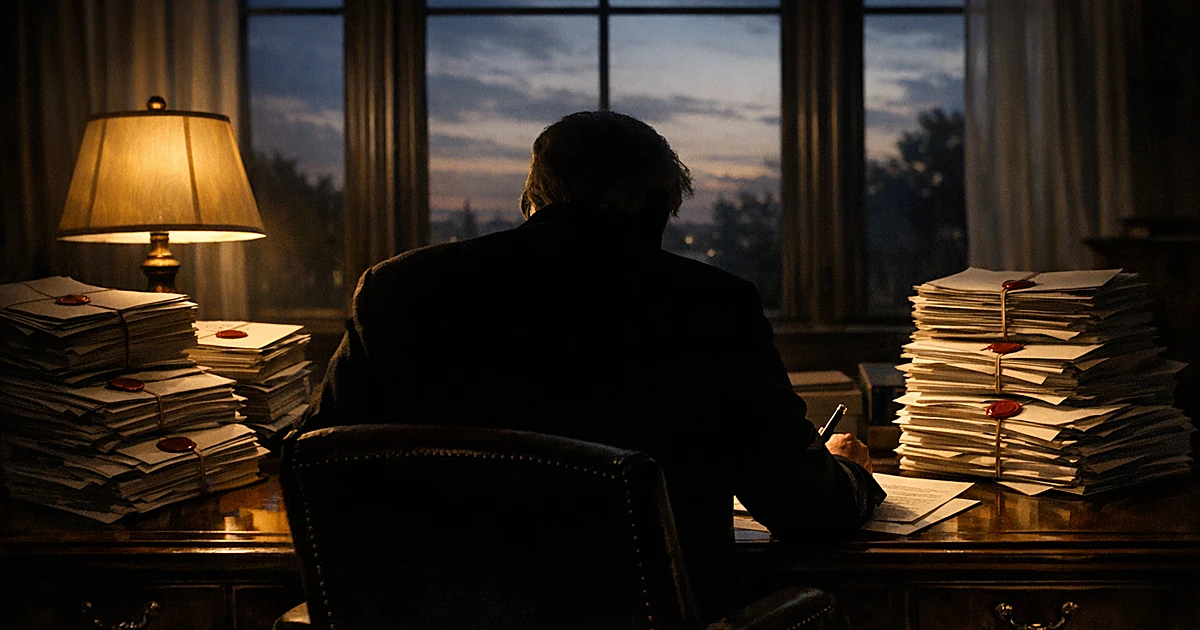
President Donald Trump has discussed granting sweeping preemptive pardons to members of his administration before leaving office, a move that would shield aides and allies from investigations Democrats have openly promised to pursue. The Wall Street Journal reported the discussions, which include the possibility of issuing anticipatory or even blanket pardons before any formal charges are brought.
No specific names have surfaced publicly. No pardon documents have been drafted or issued, as far as current reporting shows. But the conversations are real, and the political context makes the reasoning plain enough.
Democrats have spent months signaling they intend to scrutinize Trump's administration the moment he leaves the White House. Party leaders and allied groups have pointed to a range of issues they say warrant further investigation. Some Democratic lawmakers and legal analysts have questioned U.S. strikes on Iranian infrastructure, arguing that certain actions could raise legal concerns. Trump rejected those criticisms, insisting the military campaign is necessary and lawful.
If the idea of preemptive pardons sounds familiar, it should. Before Trump returned to office, Biden's own White House was openly weighing the same tool, for the same reason, in reverse. National Review reported that press secretary Karine Jean-Pierre declined to rule out preemptive pardons for Biden allies, even though none of the people under discussion were under investigation or facing charges at the time.
The names floated by Biden's team were not obscure. Former Rep. Liz Cheney, Sen.-elect Adam Schiff, and Dr. Anthony Fauci were all reportedly under consideration, Just the News reported, citing Politico. The rationale, according to Biden advisers, was that Trump's incoming team could pursue investigations or prosecutions against his critics.
Jean-Pierre framed the urgency in stark terms. "Recently announced Trump appointees for law enforcement have said on the campaign that they were out for retribution," she said. She also cited "changed circumstances" when explaining Biden's decision to pardon his own son, Hunter Biden, a pardon that covered an almost eleven-year period from 2014 to 2024.
That timeline matters. Biden's sweeping pardon of Hunter Biden set a concrete precedent for broad, time-spanning clemency actions. If a president can pardon a family member for conduct spanning more than a decade, much of it not yet charged, the legal architecture for doing the same for administration officials is already in place.
The political irony here is thick. Democrats who now object to the idea of Trump issuing preemptive pardons were, just months ago, urging Biden to do exactly the same thing. Sen. Ed Markey said publicly that if "revenge" was Trump's intention, he would recommend Biden provide preemptive pardons, "because that's really what our country is going to need." Rep. Brendan Boyle went further: "This is no hypothetical threat. The time for cautious restraint is over." Both statements were reported by the Washington Examiner.
Trump himself pushed the issue into the open well before his second term began. In a December 2024 appearance on NBC's "Meet the Press," he said Biden could pardon Democrats and January 6 Committee members, and suggested maybe he should.
"Biden can give them a pardon if he wants to. And maybe he should."
That comment, reported by Breitbart, came alongside Trump's accusation that the January 6 Committee had deleted and destroyed more than one hundred files before Republicans took control of the House. He called the destruction "illegal and unprecedented."
White House lawyers under Biden reportedly studied preemptive pardons for a wide circle of allies, including Cheney, Pelosi, Kinzinger, Gen. Mark Milley, FBI Director Christopher Wray, DOJ lawyers, and even members of the Biden family. The groundwork was laid. Whether Biden ultimately acted on every name is a separate question, but the principle was established, by Democrats, before Trump ever had to consider the same move for his own people.
Legal experts cited by the Journal described the potential move as "largely unprecedented." That framing deserves some scrutiny. Presidential pardon power under Article II of the Constitution is broad and has been exercised aggressively by presidents of both parties. Gerald Ford pardoned Richard Nixon before any charges were filed. Biden's pardon of Hunter Biden covered uncharged conduct. The mechanism is well-established; the scale Trump is reportedly considering is what would be new.
There remains genuine uncertainty about whether a preemptive pardon for individuals not currently facing criminal charges would survive legal challenge. Just the News noted that question explicitly. But the Biden precedent, pardoning Hunter Biden for a sweeping range of conduct over more than a decade, moved the goalposts considerably.
Trump has already issued clemency to large numbers of allies and supporters during his current term, often bypassing traditional Justice Department vetting processes. That pattern, reported by the Journal, suggests the administrative machinery for broad pardons already exists within this White House. The question is scope, not capability.
Meanwhile, Democrats continue to position themselves for post-presidency confrontation. The same party that demanded Trump's Cabinet invoke the 25th Amendment over his Iran remarks is now signaling it will pursue his aides through investigations and potential prosecutions the moment he steps aside.
Trump allies see the pardon discussions as a reasonable response to what they describe as politically driven probes. The president himself has framed the potential investigations as politically motivated prosecutions. Whether one agrees with that characterization depends largely on whether one trusts the institutions preparing to launch those probes.
The track record offers reasons for skepticism. Democrats have spent years weaponizing oversight and investigative authority against political opponents. Rep. Eric Swalwell, for instance, threatened to sue over the release of Chinese spy files after years of demanding transparency on Trump, a contradiction that captures the selective nature of the left's commitment to accountability.
The broader political environment reinforces the point. Trump-backed candidates continue to win elections, as Clay Fuller's Georgia special election victory demonstrated. Democratic leadership, meanwhile, faces internal fractures, Alexandria Ocasio-Cortez drew backlash from her own socialist base over moderate endorsements. A party struggling to hold itself together may not be the most credible vehicle for post-presidency legal crusades.
Several important details remain unknown. Which specific administration members are being considered for pardons? Which investigations are being anticipated? Were any pardon documents drafted? The Journal's reporting established that discussions are happening but did not name individual beneficiaries or describe the precise legal mechanisms under review.
It also remains unclear how far Trump would go. A narrow set of pardons for officials involved in specific policy decisions, like the Iran strikes Democrats have questioned, would be one thing. A sweeping blanket covering the entire senior staff would be another. The political and legal calculus differs sharply depending on the answer.
Strip away the outrage, and the underlying dynamic is straightforward. Democrats built the playbook for preemptive pardons when they feared Trump would investigate their allies. Biden's team studied it, floated names publicly, and Biden himself issued the broadest personal pardon in modern memory for his own son. Now Trump is reportedly considering the same tool to protect his people from the same kind of politically charged legal exposure.
The constitutional authority is clear. The precedent was set, by the other side. And the threat Trump's aides face is not hypothetical. Democrats have stated their intentions openly and repeatedly.
When the left built the weapon, they assumed only their side would ever pick it up. That assumption, like so many others, was wrong.