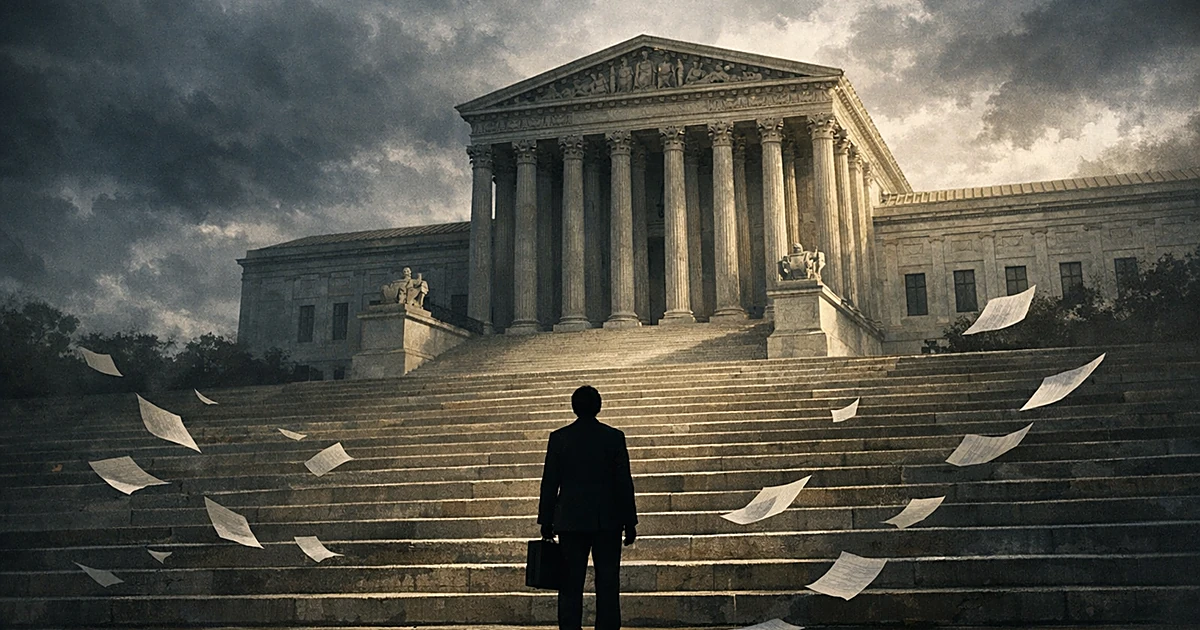
Justice Sonia Sotomayor told a law school audience Thursday that the Trump administration's use of the Supreme Court's emergency docket is "unprecedented in the court's history", a complaint that says less about executive overreach than it does about the liberal minority's frustration with losing.
Speaking at the University of Alabama School of Law, Sotomayor framed the administration's 34 emergency applications since President Trump retook the White House as a break from normal procedure. She argued the Court should wait for lower courts to work through cases before stepping in. But the numbers tell a different story about who is actually winning these fights, and why.
The Supreme Court has sided with the administration in the vast majority of those emergency cases. In roughly two dozen decisions last year alone, the conservative majority lifted lower-court orders that had blocked Trump's policies, allowing key parts of his agenda to move forward while litigation continued. That pattern is what Sotomayor is really objecting to, not the process, but the outcomes.
The administration has a straightforward explanation for its frequent emergency filings. Federal district judges, many appointed by Democratic presidents, have repeatedly issued sweeping orders blocking Trump's policies, on immigration, on firings of members of independent federal agencies, and on other executive actions. The administration says these judges are overstepping their authority to obstruct the president's lawful agenda.
That argument has weight. When a single district judge can freeze a nationwide policy with an injunction, the executive branch has limited options. It can wait months or years for the normal appeals process to grind forward, or it can ask the Supreme Court to intervene quickly. The administration has chosen the latter, and the Court's conservative majority has repeatedly agreed that intervention was warranted.
Sotomayor, however, wants the old rhythm back. As The Hill reported, she laid out her preferred approach in detail:
"We should be letting the lower courts decide these issues first before we the highest court of the land make the final decision. We should make sure that all the facts are fully aired below."
She went further, arguing the Court should wait for a circuit split, meaning different appeals courts reaching different conclusions, before stepping in.
"That the intermediate courts have looked at this, and we really shouldn't take cases and decide them until there is a circuit split, meaning that circuit courts across the country have disagreed on the answer, because then we are sure that every viable and important argument has actually been aired, that all of the important facts have actually been brought out in the various cases."
That sounds reasonable in the abstract. In practice, it would mean district judges could block presidential action for months or years with no immediate check, exactly the dynamic the administration is trying to break.
Sotomayor was not alone in her complaints. Justice Ketanji Brown Jackson, who frequently dissents in emergency orders, offered her own criticism in March. Jackson said the administration creates new policy and then demands it take effect immediately, before any legal challenge is resolved.
"The administration is making new policy... and then insisting the new policy take effect immediately, before the challenge is decided. This uptick in the court's willingness to get involved in cases on the emergency docket is a real unfortunate problem."
Jackson went even further, saying that Justice Brett Kavanaugh and the other conservatives who sided with Trump repeatedly last year "were not serving the court or the country well." The two justices sparred publicly last month over the emergency docket, a sign of how deep the internal divide runs.
But notice what Jackson's complaint actually concedes: the Court's majority keeps agreeing with the administration. If the emergency applications were frivolous, the justices would deny them. They are not.
Sotomayor identified the analytical framework she believes has tipped the scales. She said the Court's conservative majority now often starts from the presumption that blocking executive policies or laws passed by Congress causes "irreparable harm", a legal standard that, once met, makes emergency relief far more likely.
As the Washington Times reported, Sotomayor explained the practical effect plainly:
"If you start with the presumption that there is irreparable harm to one side, then you're going to have more grants of emergency relief. Because the other side is going to have a much harder time."
"It has changed the paradigm on the court," she added.
Changed it from what, exactly? From a paradigm where district judges could freeze executive action indefinitely while cases crawled through the system? That is not judicial restraint. That is judicial obstruction dressed up as process.
The administration has appealed cases related to Trump's immigration directives, including matters like the fight over Temporary Protected Status for Haitian migrants, and his firings of members of independent federal agencies. These are not minor policy disputes. They go to the core of whether a president can govern.
Sotomayor's speech fits a broader pattern. Liberal justices have increasingly used public appearances and written dissents to signal their displeasure with the direction of the Court. At the same event, Sotomayor told lawyers they should "stand up and fight," as Breitbart reported.
"Our job is to stand up for people who can't do it themselves. And our job is to be the champion of lost causes. But right now, we can't lose the battles we are facing. And we need trained and passionate and committed lawyers to fight this fight."
That is not the language of a neutral arbiter. That is the language of an advocate who happens to sit on the bench. When a Supreme Court justice tells lawyers to "fight", and the context is a sitting president's policies, the line between judicial commentary and political organizing gets thin.
The emergency docket is not the only front. The Court recently heard arguments in Trump v. Slaughter over whether the president can fire FTC Commissioner Rebecca Slaughter without cause. During those arguments, Sotomayor told the solicitor general he was "asking us to destroy the structure of government," the Washington Examiner reported. The conservative majority appeared more receptive to the administration's position, and the case could lead the Court to revisit the 1935 Humphrey's Executor precedent limiting presidential removal power.
The Court has also weighed in on cases involving Trump's birthright citizenship executive order, further illustrating the range of legal battles reaching the justices on an accelerated timeline.
Even on the emergency docket, the administration has not won every time. In December, the Supreme Court refused to intervene in a battle concerning immigration judges' speech restrictions, a rare loss for the administration in that venue. The record is not one of rubber-stamping. It is one of a Court that evaluates each application and sides with the executive branch when the legal merits support it.
There is a familiar pattern in Washington: when one side keeps losing on substance, it shifts to complaining about process. Sotomayor's speech fits that template precisely. She is not arguing that the Court's emergency rulings were legally wrong on the merits. She is arguing the Court should not have taken them up so quickly.
But the emergency docket exists for a reason. Cases on it seek quick intervention from justices in matters still working through lower courts. They are decided without oral arguments and often without written explanations. That speed is a feature, not a bug, when a lower court has blocked executive action that the Supreme Court's majority believes should proceed.
The three liberal justices, Sotomayor, Jackson, and their colleague, are outnumbered on a Court with a conservative majority. Their public frustration reflects that arithmetic. When Sotomayor says the emergency docket has "changed the paradigm," she means the paradigm has changed in ways she does not like. The conservative majority disagrees, and it has the votes.
Meanwhile, the administration continues to face a gauntlet of lower-court judges willing to issue nationwide injunctions against presidential policies, on immigration, on agency personnel, on the basic mechanics of governing. If district judges keep blocking the president's agenda on an emergency basis, the president's lawyers will keep asking the Supreme Court to respond on the same timeline.
Sotomayor calls that unprecedented. The administration calls it necessary. The Court's majority, by its actions, has made clear which side it finds more persuasive.
When the process complaint comes from the side that keeps losing on the merits, it is not a warning about the institution. It is a concession.