Los Angeles police arrested 74 people for allegedly failing to disperse after Saturday's "No Kings" demonstration in downtown Los Angeles turned from a peaceful march into a confrontation outside a federal detention center, with some protesters hurling chunks of concrete at officers and a masked demonstrator spray-painting "Kill Your Local ICE Agent" on a nearby surface, Fox LA reported.
The arrests, 66 adults and eight juveniles, came after hours of warnings, a citywide tactical alert, and what the LAPD described as non-lethal crowd-control measures deployed by federal authorities near the intersection of Alameda and Temple streets. One additional person was arrested on suspicion of possessing a dirk or dagger.
The rally had started peacefully enough. Tens of thousands gathered at Gloria Molina Grand Park, across from City Hall, around 2 p.m. Saturday. A roughly 1.5-mile march kicked off at 3 p.m. from Spring Street. But by late afternoon, a faction of demonstrators peeled away from the main crowd and headed for the federal detention center, and the tone changed fast.
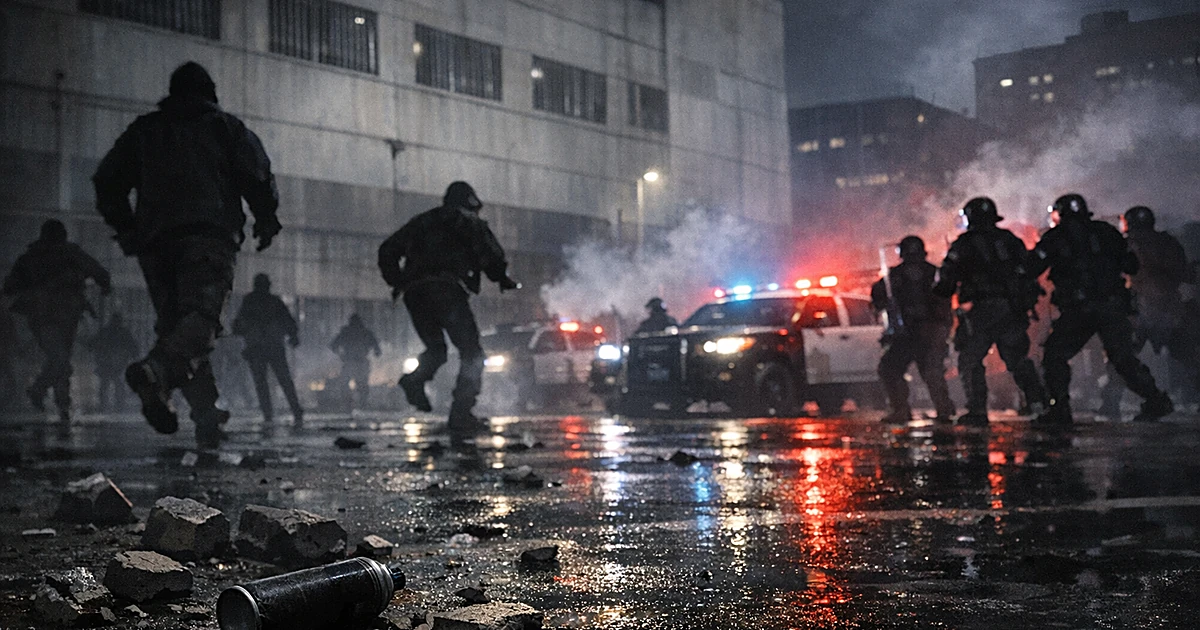
Around 5:10 p.m., the LAPD's incident commander declared a citywide tactical alert after a group of demonstrators began kicking a fence in front of the federal detention center at Alameda and Temple. The LAPD posted on social media that protesters "have been warned multiple times by federal authorities to not attempt to tear down the gate and not throw items."
Federal authorities then used what the LAPD described as "non-lethal measures to move crowd back." The Washington Times reported that the Department of Homeland Security said some protesters threw rocks, bottles, and broken concrete blocks at officers, injuring two who received medical attention.
By around 7:25 p.m., the LAPD posted that "multiple arrests being made" were underway. The tactical alert was canceled at 8:03 p.m.
Bill Essayli, first assistant U.S. Attorney for the Central District of California, did not mince words on social media:
"To those who were smashing concrete blocks and throwing them at our officers, we have you on video. We will find you and arrest you too. You've been warned."
Earlier Saturday, Essayli had posted a sharper warning still, writing that his office had "authorized immediate arrests for anyone assaulting law enforcement. You will be arrested and charged with a federal felony." He also shared a video showing a masked demonstrator spray-painting the threatening phrase near the Metropolitan Detention Center, called it "a federal crime," and posted the DHS tip line number, 866-347-2423, asking the public for help identifying the individual.
Los Angeles Mayor Karen Bass weighed in on social media with a statement that read more like a greeting card than a response to concrete being thrown at federal officers. "Peaceful protest is our constitutional right," Bass wrote. "When people come together to make their voices heard, that is democracy in action. Please stay safe and look out for one another."
What Bass did not address: the violence, the graffiti calling for the killing of ICE agents, or the 74 arrests. Her statement made no mention of the demonstrators who tried to tear down a fence at a federal facility, nor the officers struck by debris. The gap between her words and the evening's events speaks for itself.
The Washington Examiner reported that authorities declared an unlawful assembly after a group of roughly 150 to 200 protesters allegedly threw rocks, bottles, and concrete at Department of Homeland Security officers. At least two officers were struck by concrete and needed medical care. The Examiner's count put total arrests at 75, one higher than the LAPD figure reported by City News Service.
The administration's handling of arrest-related public communications has itself become a flashpoint. Federal judges have recently clashed with the DOJ over social media posts publicizing arrest photos, a sign that law enforcement transparency in politically charged cases is under growing judicial scrutiny.
The Los Angeles demonstration was the largest flashpoint in what organizers called a nationwide day of action against the Trump administration. The group 50501 claimed more than 3,300 events across all 50 states, with at least eight million participants, a figure it called "the largest single-day nationwide demonstrations in US history." That claim has not been independently verified.
Newsmax reported that organizers said more than 3,100 events were registered, with demonstrations also held in Europe and other countries. Most were described as peaceful. Los Angeles was the notable exception.
Within Los Angeles County alone, at least 40 separate demonstrations took place Saturday, with events in Burbank, Culver City, Hollywood, Long Beach, Malibu, Venice, Woodland Hills, and Rancho Palos Verdes, where a protest was held outside Trump National Golf Club. More than a dozen additional events were held across Orange County, in cities including Anaheim, Huntington Beach, Newport Beach, Santa Ana, and Westminster.
In Malibu, Doug Emhoff, husband of former Vice President Kamala Harris, spoke at a rally held near their home. Comedian Kathy Griffin and actor Sam Elliott also attended. The downtown Los Angeles event featured scheduled speakers including actress Jodie Sweetin and Becky Pringle, president of the National Education Association, which bills itself as the nation's largest union representing public school teachers and other education personnel.
Organizers framed the day in sweeping terms, stating: "As unconstitutional deportations and inhumane treatment of immigrants and asylum seekers continue across the United States, and as illegal and unauthorized wars are perpetrated around the globe, Los Angeles unites in solidarity with a peaceful march and rally." That framing sat uneasily beside the evening's images of torn fencing, thrown concrete, and tear gas.
Andre Andrews Jr., a Navy veteran and independent journalist who was present, drew a clear line between the marchers and the agitators. As Breitbart reported, Andrews said: "The peaceful protest was good for the cause. You have the right to do that. But the other people, they were definitely causing problems."
That distinction matters. Tens of thousands of people showed up, marched, and went home. A smaller group chose a different path, one that led to a federal detention center, a torn fence, and felony warnings from a U.S. Attorney's office.
White House spokeswoman Abigail Jackson dismissed the protests entirely. She told the New York Times that "the only people who care about these Trump derangement therapy sessions are the reporters who are paid to cover them." Whether that framing holds when two federal officers are receiving medical treatment for concrete impacts is another matter.
Several questions remain open. What specific criminal charges, if any, will be filed against the 74 arrestees beyond failure to disperse? How many of the arrests were tied to alleged violence versus simply remaining in the area after the dispersal order? Were any protesters injured? The LAPD has not publicly detailed the non-lethal measures used, and the specific federal agency whose officers were targeted with thrown debris has not been identified.
Caltrans had anticipated trouble. Crews placed security gates along on- and off-ramps to the Hollywood (101) Freeway in the downtown area on Friday, a day before the rally. Streets in the Civic Center area, including sections of Broadway and Spring Street, were blocked Saturday. The city knew what was coming. The question is whether it did enough to prevent the predictable escalation.
The broader pattern is hard to miss. When defendants in politically charged cases test the boundaries of legal accountability, and when federal agencies face internal upheaval over investigations with political overtones, the public's confidence in equal enforcement of the law erodes. What happened outside that detention center Saturday evening was not a gray area. Throwing concrete at officers is a crime. Spray-painting threats against federal agents is a crime. Essayli said as much plainly.
The right to protest is not in question. The First Amendment protects speech, assembly, and the airing of grievances, even loud, angry ones. What it does not protect is assaulting federal officers, attempting to breach a detention facility, or painting messages inciting violence against law enforcement.
Mayor Bass chose to celebrate "democracy in action" while saying nothing about the violence. Organizers chose to frame the day as peaceful solidarity while a faction of their crowd threw concrete. The gap between the rhetoric and the record is wide enough to drive a Caltrans truck through.
When leaders refuse to name what went wrong, they guarantee it will happen again. And the people left to deal with the consequences, the officers, the taxpayers, the residents whose streets were blocked and whose city was vandalized, deserve better than platitudes about democracy in action.