Federal prosecutors say a 21-year-old Pennsylvania man who pledged allegiance to ISIS was arrested at a hotel with a semiautomatic rifle and nearly 200 rounds of ammunition, just two years after a juvenile adjudication for a separate mass-casualty plot.
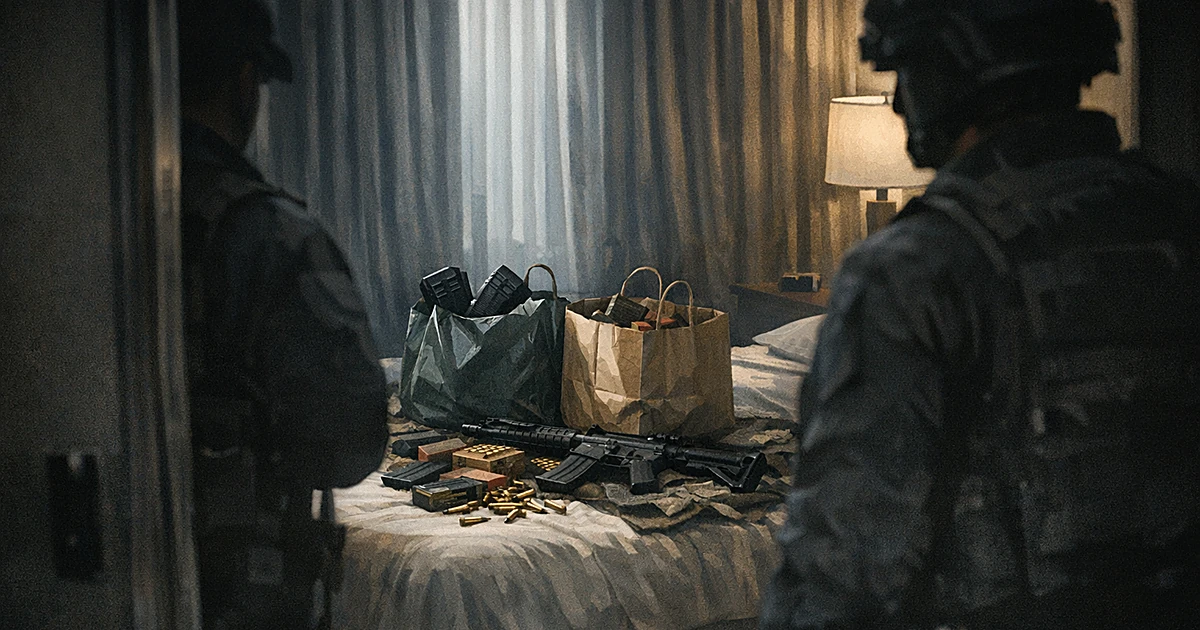
FBI agents tracked Jonathan Hunter Kramer from his home in Valencia, Pennsylvania, to a hotel in nearby Cranberry Township, where they confronted him carrying two bags from a sporting goods store and seized a cache of weapons, according to Fox News. Searches of Kramer, his hotel room, and his home turned up a semiautomatic rifle, five rifle magazines, two loaded, three capable of holding 30 rounds each, 190 rounds of rifle ammunition, a rifle scope and bipod, an entrenchment tool, pepper spray, and roughly 30 knives.
The DOJ charged Kramer with receiving a firearm and ammunition knowing or having reasonable cause to believe they would be used to commit a felony or a federal crime of terrorism, including providing or attempting to provide material support to a designated foreign terrorist organization. Prosecutors asked the court to hold him without bond, calling him a danger to the community. He made his first court appearance Monday and was booked into the Butler County Jail.
Kramer was not unknown to the FBI. In 2023, while still a minor, he was charged and adjudicated delinquent in Pennsylvania for his role in a plot to carry out a mass-casualty attack. That same juvenile investigation also found him in possession of child sexual abuse material. He was sent to a juvenile detention facility, and eventually released.
Then came March 19, when an anonymous tipster contacted authorities. The tipster said Kramer had been ordering "mysterious" packages and "talking to his friends from before", a reference to contacts from the period of his juvenile adjudication. The FBI reopened its investigation.
What agents found was not reassuring. Federal prosecutors say Kramer had pledged allegiance to ISIS, adopted the online name "Hamza Al Rashid," claimed ISIS affiliation, and offered to distribute explosives manuals. He wrote about preparing for his "mission" and said he was missing a "weapon." The DOJ has not identified a specific target for the alleged attack.
The case fits a broader pattern of federal law enforcement acting on tips and building evidence before suspects can carry out planned violence, a pattern visible in recent record-breaking federal arrest operations across multiple agencies.
On Friday, FBI agents watched Kramer leave his Valencia home carrying a bag. He took a rideshare to a store, where he bought a disposable phone, a step consistent with someone trying to avoid electronic surveillance. From there, he met an unidentified person in a parking lot and took a long black bag from the trunk of a vehicle.
Kramer then traveled to a hotel in Cranberry Township and paid cash for a room. Witnesses at the store and the hotel told investigators that the bag made a metallic clicking sound when Kramer set it down, Breitbart reported.
After checking in, Kramer went to a sporting goods store, where agents observed him at the gun counter. When he returned to the hotel carrying two bags from the store, agents moved in.
A handwritten note found on Kramer read: "DoNt look For me[.] IDK what I did buT I cant live In constant Fear[.]" Prosecutors have presented the note as part of the evidence in the federal complaint. The note's tone, part farewell, part confession, suggests Kramer may have anticipated the encounter would end differently than a quiet arrest at a hotel door.
Attorney General Todd Blanche announced the arrest and placed it in the context of the 25th anniversary of the September 11 terrorist attacks. He praised the agents and investigators who built the case.
As the New York Post reported, Blanche said:
"Their outstanding work thwarted this alleged attack before innocent lives could be lost."
FBI Director Kash Patel said Kramer had been "plotting a violent attack in support of ISIS," citing the suspect's online activity and his acquisition of weapons. The FBI's full statement was not published in detail, but the partial quote underscores the bureau's position that this was not idle online chatter, it was operational planning backed by real hardware.
Federal law enforcement has faced scrutiny in recent years over whether it prioritizes the right threats. Cases like this one, where agents acted on a tip, surveilled a known subject, and intercepted him before he could act, represent the kind of proactive work that Americans expect from their federal agencies.
One question the DOJ's announcement does not answer is how Kramer, adjudicated delinquent for involvement in a mass-casualty plot and for possessing child sexual abuse material, ended up free and unsupervised enough to acquire a semiautomatic rifle, nearly 200 rounds of ammunition, and dozens of knives. The juvenile justice system, by design, treats minors differently from adult offenders. But the gap between Kramer's 2023 adjudication and his 2026 arrest raises hard questions about monitoring, release conditions, and the limits of a system built around rehabilitation rather than incapacitation.
The anonymous tipster who flagged Kramer's behavior, the mysterious packages, the old contacts, did what the system apparently could not. That tip, received on March 19, set the entire investigation in motion. Without it, Kramer's preparations might have continued unchecked.
Several unanswered questions remain. Who was the unidentified person who handed Kramer a bag from a car trunk in a parking lot? What were the "mysterious" packages the tipster described? What platforms did Kramer use under his ISIS-affiliated alias? And what, specifically, was the target? The DOJ said explicitly that no specific target had been identified, which could mean investigators intervened before Kramer settled on one, or that the information remains sealed.
Prosecutors' request that Kramer be held without bond signals their view that he remains a serious threat. Given his juvenile record, his alleged ISIS pledge, and the arsenal agents recovered, the argument for detention is straightforward. The case now moves through the federal court system, where the evidentiary standard is far higher than in juvenile proceedings, and the consequences far more severe.
As courts and prosecutors continue to handle cases built on physical evidence and digital records, Kramer's prosecution will test whether the federal system can deliver the accountability that the juvenile system plainly did not.
An anonymous citizen picked up the phone and did what needed doing. The FBI followed through. The system worked this time, but only because someone outside the system forced it to.