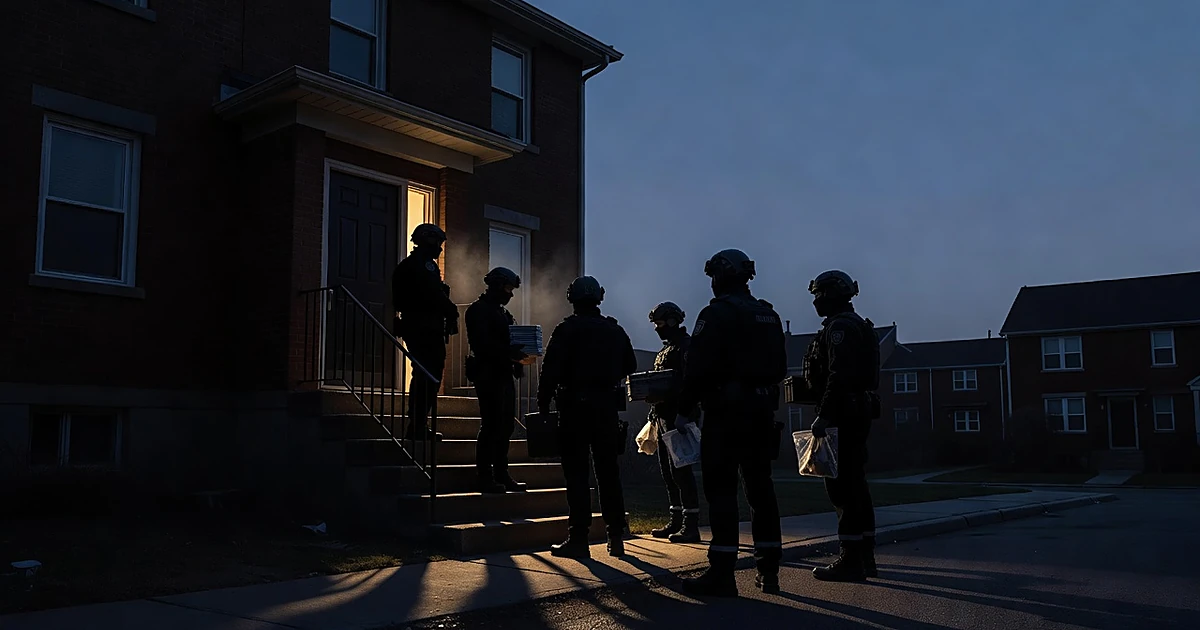
A three-month FBI operation targeting violent offenders, drug traffickers, armed felons, and fugitives produced 1,139 arrests, 615 criminal indictments, and nearly a thousand firearm seizures across major American cities, the Justice Department announced Monday.
The operation, dubbed Operation Spring Cleaning, spanned Charlotte, North Carolina; Chicago; Dallas; Houston; Philadelphia; and Sacramento, California. An FBI document reviewed by Fox News Digital detailed the scope: 1,474 joint operations, 586 search warrants, and 984 firearms pulled off the streets.
FBI Director Kash Patel framed the results as part of a deliberate shift in how the bureau deploys its resources, away from Washington turf battles and toward the violent crime that grinds down American neighborhoods.
The drug seizures alone tell a story about what was flowing through these communities before agents moved in. Law enforcement confiscated 509 kilograms of cocaine and 48 kilograms of fentanyll, the FBI document showed. The Justice Department added that authorities seized 698 pounds of methamphetamine, 567 pounds of marijuana, 7.4 kilograms of crack cocaine, 38 kilograms of heroin, and 13,260 MDMA pills.
In Dallas, agents went beyond drugs and guns. They seized $20,000 worth of jewelry and a Mercedes-Benz, the kind of assets that signal organized criminal enterprise, not petty street crime.
The Justice Department said the operation targeted people accused of spreading drugs, driving gun violence, and increasing crime across district and state lines. That cross-jurisdictional focus matters. As Reid Davis, the special agent in charge of the FBI's Charlotte office, put it:
"People willing to commit violent crimes don't care about city and county lines."
It's a plain observation, but it captures why federal coordination exists in the first place, and why letting it atrophy has consequences.
Patel did not mince words about what he sees as the FBI's renewed direction. He told Fox News Digital:
"Operation Spring Cleaning is the latest success story in this FBI's full-throttle mission to surge resources all across the country, crushing violent crime and saving American lives."
He placed the operation in a broader sequence of enforcement actions, Summer Heat, Viper, Grayskull, and others, that he says have produced historic results.
"Whether it's Summer Heat, Viper, Grayskull, Spring Cleaning, or others, these are the ops that have delivered the most prolific run of crime reduction in United States history."
That's a bold claim, and the final numbers will need independent verification over time. But 1,139 arrests and 615 indictments in a single operation represent a serious output of federal law enforcement energy directed at the people who make American cities dangerous.
Patel has been a polarizing figure since taking over the bureau, and his leadership has drawn scrutiny from Democrats on Capitol Hill. He previously accused the bureau of lying to obtain surveillance warrants during the 2016 campaign, a charge that defined his reputation long before he held the director's title.
But whatever one thinks of those earlier fights, the operational results announced Monday are concrete and measurable. Guns seized. Drugs confiscated. Warrants executed. People arrested.
FBI Deputy Director Chris Raia reinforced Patel's message, describing Operation Spring Cleaning as evidence of a sustained commitment rather than a one-off press release.
"Along with our partners, we're protecting our communities, reducing crime stats nationwide, and producing record numbers of arrests and seizures. We remain focused on carrying out our mission to crush violent crime and defend the homeland, and we've only just begun."
The phrase "only just begun" signals the bureau intends to continue this operational tempo. For communities in Chicago, Houston, and Philadelphia that have endured years of rising violence, that's a promise worth tracking.
The Monday announcement came just days after the FBI released results from a separate operation. On Friday, authorities said Operation Soteria Shield, a joint takedown between the FBI and Texas authorities, resulted in more than 276 arrests for suspected child exploitation and the rescue of 89 children. The back-to-back disclosures suggest a bureau eager to show that its enforcement pipeline is producing at volume.
The FBI has also remained active on other fronts. Agents recently arrested a protester who allegedly threatened to kill an ICE officer's family outside a Newark detention center, a reminder that threats against federal law enforcement are being taken seriously under the current leadership.
Operation Spring Cleaning fits into a still-larger framework. Authorities said the sweep supports the Justice Department's broader efforts under Operation Take Back America, a nationwide initiative aimed at repelling illegal immigration and eliminating drug cartels and transnational criminal organizations.
That umbrella initiative reflects a deliberate policy choice: linking street-level violent crime to the cross-border networks that supply the drugs, weapons, and manpower fueling it. Whether that linkage holds up across every case in the 615 indictments remains to be seen. But the strategic framing is clear, the administration views domestic violent crime and border security as two sides of the same problem.
The bureau has also been handling high-profile investigative work beyond street crime. Patel announced the FBI was investigating the Old Dominion University shooting as an act of terrorism, a decision that carries significant legal and resource implications.
Meanwhile, the FBI's own institutional history continues to generate headlines. Former FBI Director James Comey faces a July 15 criminal trial over an alleged threat against President Trump, a case that underscores just how dramatically the bureau's leadership culture has shifted.
Several questions remain unanswered. The FBI document reviewed by Fox News Digital does not break down arrests or indictments by city. It does not name defendants. It does not specify which courts or jurisdictions are handling the 615 indictments, or what specific charges were filed. The exact start and end dates of the three-month operation have not been disclosed.
None of that is unusual for an operation of this scale at the announcement stage. Indictments are public documents, and the details will emerge as cases move through federal courts. But the gap between headline numbers and granular accountability is worth noting, not as a criticism, but as a marker for follow-up.
What is clear right now: 984 firearms are off the street. More than half a metric ton of cocaine and 48 kilograms of fentanyl, enough to kill millions, are out of the supply chain. And 1,139 people accused of violent crime, drug trafficking, or fugitive status are in custody.
For years, the FBI's public image was dominated by political controversies, surveillance abuses, leaked investigations, and congressional showdowns. The bureau became a symbol of institutional distrust for millions of Americans who felt it had been weaponized against their political interests.
Operations like Spring Cleaning and Soteria Shield tell a different story. They represent the kind of work most Americans, regardless of party, want the FBI doing: finding violent criminals, seizing illegal weapons, pulling deadly drugs off the streets, and rescuing exploited children.
Patel acknowledged the agents and partners who carried out the work. "These surges truly save lives, and I couldn't be prouder of our agents and partners who executed them," he said.
The real test is whether this pace holds. One operation makes a press conference. A sustained pattern makes a record. For now, 1,139 arrests in three months is a start that speaks for itself, and a reminder that when the FBI focuses on criminals instead of politics, the results are hard to argue with.