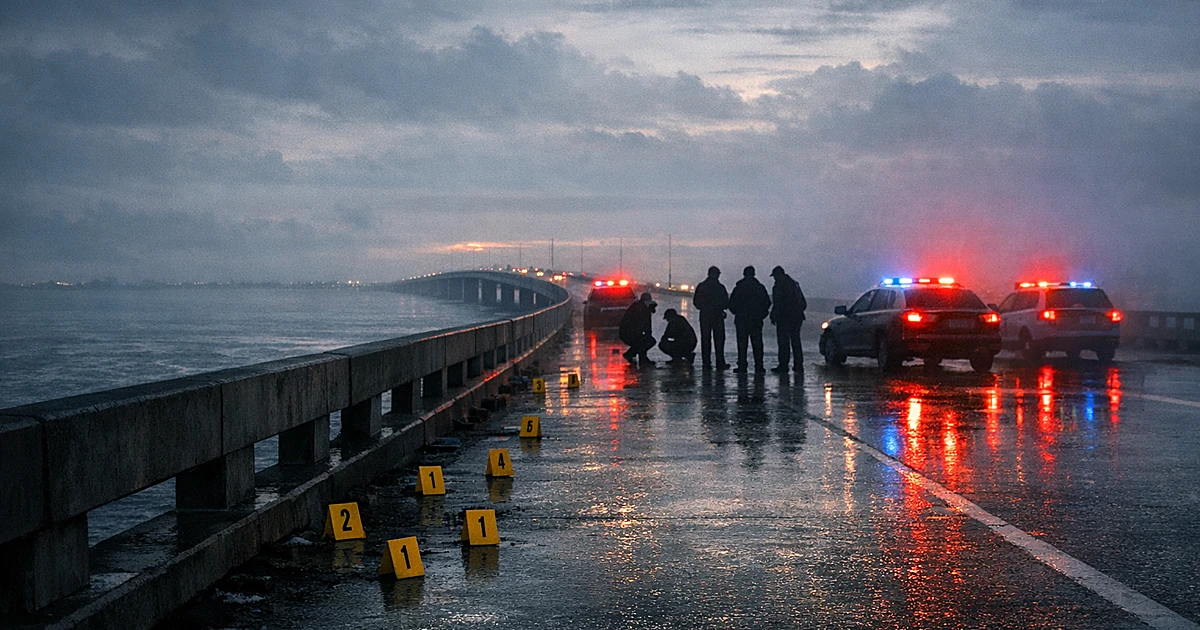
Authorities in Hillsborough County, Florida, found the body of missing University of South Florida doctoral student Zamil Limon on the Howard Frankland Bridge on Friday morning, and within hours, his roommate was in custody facing charges that have since been upgraded to two counts of first-degree murder. The second missing student, Nahida S. Bristy, has not been found.
The grim discovery ended one search and deepened another. Limon, 27, a Bangladeshi national pursuing a doctorate in geography, environmental science, and policy, had not been seen since April 16. Bristy, also 27 and from Bangladesh, was last spotted that same day on the USF Tampa campus. Both vanished within an hour of each other. Neither had been heard from since.
Their roommate, 26-year-old Hisham Saleh Abugharbieh, now stands charged with two counts of first-degree premeditated murder with a weapon, AP News reported. He is a former USF student who had been enrolled from spring 2021 through spring 2023, pursuing a bachelor's degree in management. He was not a current student at the time of his arrest.
The arrest came after the Hillsborough County Sheriff's Office received a domestic violence call at Abugharbieh's home around 9 a.m. Friday, Chief Deputy Joseph Maurer said at a news conference. Family members at the residence were able to leave and get to safety. Deputies ordered the suspect to come out. He refused.
After roughly 20 minutes, a SWAT team was called to the scene. Abugharbieh eventually came out peacefully and was taken into custody, NBC News reported.
His initial charges told a disturbing story even before prosecutors upgraded them: domestic violence, simple battery, false imprisonment, tampering with evidence, failure to report a death, and unlawfully holding or moving a dead body. Hillsborough County Sheriff Chad Chronister confirmed Abugharbieh faced charges for "failure to report a death and unlawfully moving a body," the New York Post reported.
The charge of unlawfully moving a body raises hard questions about what happened to Limon between April 16, when he was last seen alive in his Tampa residence, and Friday morning, when his remains turned up on a major bridge spanning Tampa Bay.
By Saturday, authorities had escalated the case dramatically. The Hillsborough County Sheriff's Office said evidence was presented to the State Attorney's Office, resulting in two counts of first-degree premeditated murder with a weapon, one for Limon, one for Bristy, Fox News reported.
That second charge is notable. Bristy has not been found. Her body has not been recovered. Yet prosecutors apparently believe the evidence supports a murder charge in her case as well. The Hillsborough County Sheriff's Office said in a statement Saturday that "the search for Bristy continues."
Missing-person cases that end with a body recovered far from the last known location are a grim pattern in American law enforcement. A recent case in Scottsdale, Arizona, where a missing Native woman's body was pulled from a canal, underscored how often these searches end in tragedy rather than reunion.
The timeline leading up to the discovery deserves scrutiny. Limon was last seen at 9 a.m. on April 16 in his Tampa residence. Bristy was last seen one hour later, at 10 a.m., in the Natural and Environmental Sciences Building on the USF Tampa campus. Both were 27. Both were from Bangladesh. Both were doctoral students.
Yet it was not until "last Friday", roughly a week later, that a family friend reported being unable to contact either student. That call came just before 5 p.m. It triggered missing person reports: the Hillsborough County Sheriff's Office processed Limon's report, while the USF Police Department handled Bristy's. Police then entered both students into missing person databases.
The gap between disappearance and report is not unusual in cases involving adults, but it raises uncomfortable questions about campus safety infrastructure. Two doctoral students vanished from the same university community on the same day, and no institutional alarm sounded for days.
Bristy's older brother, Zahaid Hasan Pranto, 29, told NBC News that Bristy and Abugharbieh had a romantic relationship in the past but were not actively dating at the time of her disappearance. The nature of that prior relationship, and whatever dynamics existed among the three people sharing a living arrangement, remains a central question for investigators.
The ongoing search for Bristy echoes other high-profile missing-person cases in which families and communities have waited weeks or longer for answers.
The initial slate of charges against Abugharbieh painted a picture of concealment. Tampering with evidence. Moving a body. Failing to report a death. These are the charges of someone who, law enforcement alleges, knew a person was dead and took steps to hide it.
The upgrade to two counts of first-degree premeditated murder with a weapon goes further. It alleges planning and intent. The Washington Examiner reported that Abugharbieh faces the premeditated murder charges in the deaths of both Limon and Bristy, even though only Limon's remains have been recovered so far.
An autopsy is being performed to determine Limon's cause of death, the Hillsborough County Sheriff's Office said. No motive has been publicly stated by authorities.
The decision to charge murder in Bristy's case without a body suggests investigators have gathered substantial evidence, physical, digital, or testimonial, pointing to her death. Prosecutors do not typically bring first-degree murder charges on speculation, particularly in a case drawing national attention.
Cases involving concealment of remains have drawn public attention before. A California woman was recently sentenced to 15 years for killing her boyfriend and hiding his body in a backyard for eight years, a reminder that the act of concealment often compounds the original crime in the eyes of the law.
The University of South Florida confirmed Abugharbieh's enrollment history: spring 2021 through spring 2023, pursuing a bachelor of science in management. He was not a current student. The school's police department issued a statement Tuesday confirming both Limon and Bristy had been reported missing.
Limon's remains were positively identified near the Howard Frankland Bridge, Newsmax reported, confirming the worst fears of his family and the university community. The bridge spans Old Tampa Bay, connecting Tampa to Clearwater, a public, heavily trafficked span that makes the placement of remains there all the more disturbing.
For the families of both students, young scholars who traveled from Bangladesh to pursue advanced degrees in the United States, the ordeal is far from over. One family now mourns a confirmed death. The other waits, with a murder charge filed but no body recovered.
Investigations into missing persons can drag on for months or years when remains are not found, as recent scrutiny of the Nancy Guthrie disappearance case has shown. The families and the public deserve answers delivered with speed and competence.
Several critical facts remain unknown. What was the cause of Limon's death? What evidence led prosecutors to charge murder in Bristy's case without recovering her body? What was the weapon referenced in the charges? And what happened inside that Tampa residence between April 16, when both students were last seen, and Friday morning, when a domestic violence call finally brought deputies to the door?
The Hillsborough County Sheriff's Office has said the investigation into Bristy's disappearance remains ongoing. Chief Deputy Maurer confirmed the search continues.
Two young people came to this country to study. One is dead. The other is missing. The man charged with killing them lived under the same roof. Whatever the courts determine about Hisham Abugharbieh's guilt, the facts already on the record demand a full accounting, for the victims, for their families, and for every student who trusts that a university town is a safe place to pursue a future.