A billionaire entrepreneur who says he won't run for president polls better against a generic Republican in 2028 than the woman who just lost the White House. That is the state of the Democratic Party heading into its next nominating fight, and the numbers come from the party's own voters.
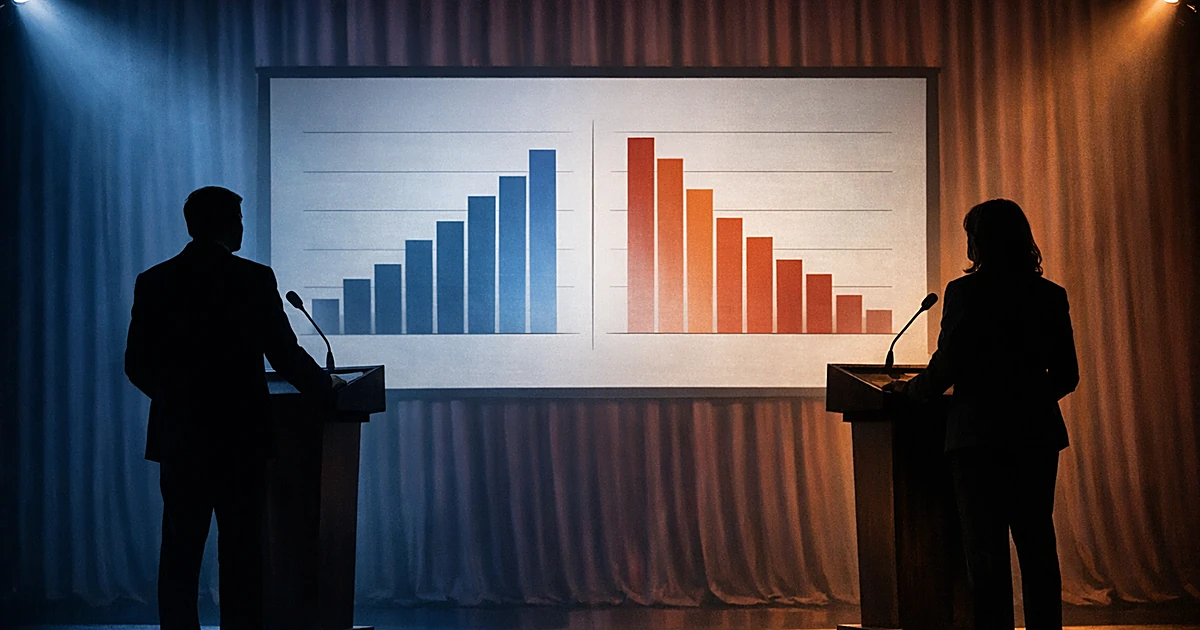
A Yale Polling survey reported by Newsmax found that 58 percent of respondents said Mark Cuban would defeat a Republican candidate in the 2028 presidential election. Only 55 percent said the same about former Vice President Kamala Harris. The gap is narrow, but the symbolism is not: a man with zero electoral experience edges out the party's most recent standard-bearer.
The Yale Youth Poll surveyed 3,429 registered voters online from March 9 to 23, with an under-35 oversample of 2,008. The margin of error was plus or minus 1.4 percentage points for the full sample and 2.0 points for the youth sample. And Harris didn't just trail Cuban. She trailed nearly everyone the poll tested.
California Gov. Gavin Newsom dominated the hypothetical general-election question at 72 percent, no other name came close. Arizona Sen. Mark Kelly followed at 70 percent. Kentucky Gov. Andy Beshear and Illinois Gov. JB Pritzker tied for third at 64 percent. Former Transportation Secretary Pete Buttigieg came in fifth at 61 percent.
Cuban, at 58 percent, and Harris, at 55 percent, brought up the rear. For a former vice president who has largely retreated from public view since her loss, the results are a blunt verdict from her own side.
Harris said earlier this month that she was "thinking about" running for president in 2028. The poll suggests Democratic voters are thinking about other options, and finding most of them more appealing.
The Yale survey also tested a hypothetical 2028 Democratic primary, and the results exposed a sharp age divide within the party. Younger Democrats between the ages of 18 and 34 favored Harris at 61 percent and Rep. Alexandria Ocasio-Cortez of New York at 47 percent.
Older Democrats went a different direction entirely. They preferred Newsom at 28 percent and Buttigieg at 19 percent. The split matters because it previews the kind of intraparty fight that could consume Democratic resources and attention for the next three years.
That tension, between a younger progressive wing drawn to Harris and Ocasio-Cortez and an older establishment gravitating toward governors and former cabinet officials, has been simmering since 2024. As one Obama strategist recently argued, Democrats still haven't reckoned with the lessons of that cycle.
For his part, Cuban has been direct about his intentions. He told interviewers flatly:
"I'm not going to do it."
But he left one door open. Cuban said the only scenario that would change his mind involves President Donald Trump seeking an unconstitutional third term:
"I've said the only way I would do it is if Trump tried to run for a third term. Because then that's just changing everything, right? And that's a true threat."
Cuban cited his family as the main reason to stay out. He said his three children are between the ages of 15 and 21.
"But other than that, I'm not going to put my family through that, you know?"
He also framed the decision in personal terms, suggesting a presidential run wouldn't be the legacy he wants. Cuban said he didn't want to reach the end of his life and say, "Well, gee, I ran for president. Maybe won, maybe didn't."
The poll's most telling detail isn't Cuban's 58 percent or Harris's 55 percent in isolation. It's the distance between both of them and the top of the field. Newsom's 72 percent and Kelly's 70 percent suggest that Democratic voters, when asked to imagine a competitive general election, reach for governors and senators with executive or legislative credentials, not for the woman who carried the party's banner just months ago.
Harris's position near the bottom of her own party's rankings is consistent with a broader pattern. She has been dogged by reports of internal friction within her political operation and has struggled to maintain a visible public role since leaving office.
The fact that a tech entrepreneur who has never held office, and who insists he isn't running, outpolls her should force an honest conversation inside the party. It hasn't yet. Democrats remain caught between a young base that wants ideological purity and an older wing that wants electability, with no consensus figure bridging the gap.
Newsom, who has positioned himself as a prominent voice opposing President Trump, leads both wings for now. But early frontrunner status in a presidential primary is notoriously fragile, and the California governor's national profile carries its own liabilities outside deep-blue territory.
The Yale Youth Poll's spring 2026 results drew from an online sample of 3,429 registered voters. The under-35 oversample of 2,008 was designed to capture younger voter sentiment with greater precision. The full-sample margin of error was plus or minus 1.4 percentage points; the youth-sample margin was 2.0 points.
The poll did not specify which Republican candidate or candidates were used in the hypothetical matchup, and the exact wording of the survey questions was not published in the reporting. Those gaps matter. A generic-ballot question can produce different results than a named-opponent matchup, and the absence of that detail limits how far any conclusion can be pushed.
Still, even with those caveats, the directional finding is clear: Democratic voters see a long list of alternatives they consider stronger than Harris. That list now includes someone who has never run for so much as city council.
The broader pattern of prominent Democrats fading from public life only deepens the vacuum. When the party's most recognizable figures step back and its most recent nominee polls behind a billionaire who says he's staying home, the bench isn't thin. It's a warning.
Democrats spent 2024 telling voters they had the strongest possible candidate. Now their own poll numbers say otherwise, and the person who proves it doesn't even want the job.