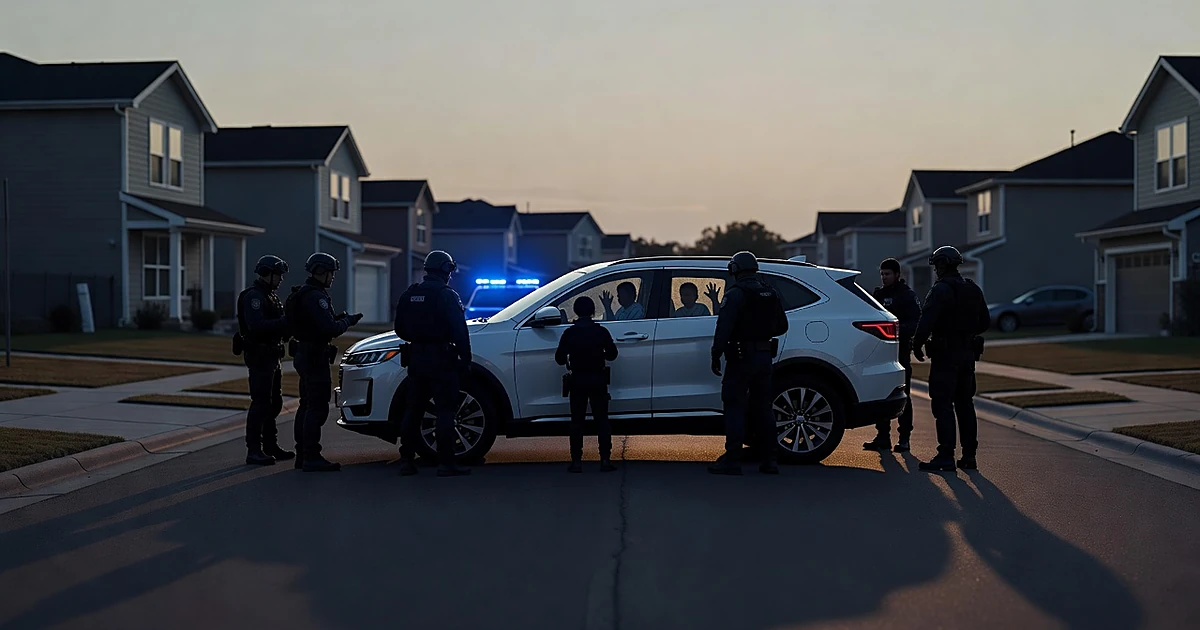
Body camera footage from a Martin County, Fla., deputy captures Tiger Woods ending a phone call and telling the officer, "Yeah, I was just talking to the president," moments before his arrest on DUI charges following a March 27 rollover crash near his home on Jupiter Island.
The footage, obtained Thursday by multiple outlets, shows Woods wrapping up a call with the words, "Thank you so much. All right. You got it. Bye. Thank you," before the deputy asks him to stay put. It was unclear whether Woods was in fact speaking with President Trump, as audio from the other end of the call was unavailable. The White House did not return a request for comment.
What is clear: the 50-year-old golfer told authorities he was looking at his phone and changing the radio station when his Land Rover clipped the back end of a pickup truck and flipped. Deputies found two white pills at the scene, according to WFLA. After conducting a sobriety test, Martin County Deputy Sheriff Tatiana Levenar delivered the verdict:
"I do believe your normal faculties are impaired, and you're under an unknown substance, so at this time you're under arrest for DUI."
Woods has pleaded not guilty to the charges.
On Tuesday, Woods announced he was temporarily stepping away from golf. He had been expected to return to the Masters tournament in Augusta, Ga., this week. Instead, he issued a statement saying the break was necessary "to seek treatment and focus on my health," The Hill reported.
"This is necessary in order for me to prioritize my well-being and work toward lasting recovery."
For a man who has defined American athletic greatness across three decades, that sentence carries enormous weight. Woods isn't some flash-in-the-pan celebrity spiraling on a reality show. He is a generational talent, a Presidential Medal of Freedom recipient, and someone whose struggles with injury and personal turmoil have played out on one of the most public stages in the world.
That doesn't excuse driving impaired. It does contextualize the stakes.
President Trump, an avid golfer who awarded Woods the Presidential Medal of Freedom during his first term, spoke to Reuters on Wednesday about Woods's decision to seek treatment. His tone was one of loyalty and confidence.
"It's a good thing that he's doing, but he's going to end up being terrific. He's a great guy."
"He's one of the greatest people I've known. He's a great champion … he'll be fine."
Whatever the nature of the phone call captured on the body camera, Trump's public posture toward Woods has been consistent: support for the man, encouragement toward recovery. That kind of personal steadiness from a president matters more than the media's inevitable effort to turn a friendship into a scandal.
The body camera video is going to generate days of coverage, most of it fixated on the presidential name-drop. Cable news will loop the clip. Pundits will speculate about what was said on the other end of that call. Social media will do what social media does.
None of that changes the core facts:
The legal process will sort out the charges. The more interesting question is whether Woods can actually do what he says he's going to do. Recovery is not a press release. It's not a well-crafted statement from a PR team. It is daily, grinding, unglamorous work that most people never see.
There is a predictable pattern when famous people face moments like this. The left-leaning entertainment press will oscillate between performative sympathy and voyeuristic glee. The recovery industrial complex will offer Woods as a mascot. And somewhere in the noise, the actual human being at the center of it all will either do the work or he won't.
Conservatives have always understood that personal responsibility is not a slogan. It is the operating system. Woods broke the law. He is facing the legal consequences. He says he is seeking help. Those are the facts, and they deserve to be treated with the seriousness that any DUI warrants, regardless of the defendant's fame or friendships.
Trump called Woods "a great champion." Champions are defined not by the absence of failure but by what they do after it. The footage from Martin County is difficult to watch. What comes next will determine whether it's a chapter or a conclusion.