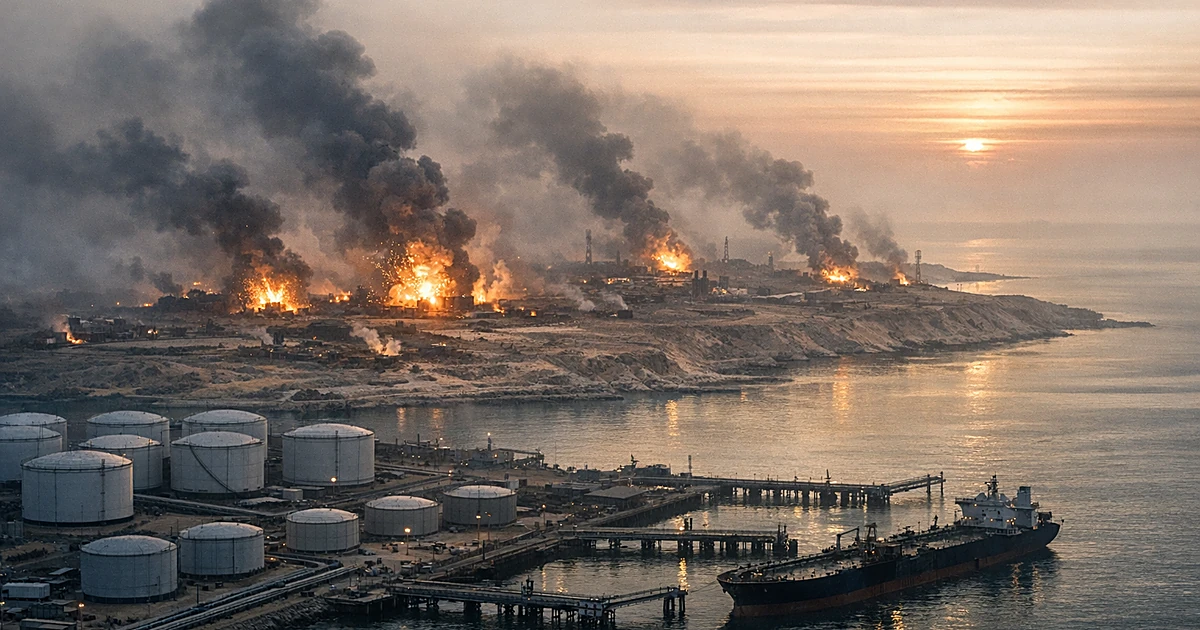
Two U.S. officials told Reuters that potential military strikes on Iran could target specific individuals and even pursue regime change, options that have emerged in the planning stage if ordered by President Donald Trump. The officials spoke on condition of anonymity and did not say which individuals could be targeted.
The report landed the same day Trump said Friday that he is "considering" a limited military strike on Iran to pressure its leaders into a deal over its nuclear program. The president made the remarks at the White House, where the calculus on Tehran appears to be shifting from diplomacy-first to something with considerably sharper teeth.
This is not abstract saber-rattling. The USS Gerald R. Ford is heading to the Middle East. The U.S. is building up its military presence in the region. And the president has put a clock on the negotiations.
On Thursday, Trump suggested the window for a breakthrough is closing fast, putting the timeline at "10, 15 days, pretty much maximum." He followed that with a statement that left little room for misinterpretation:
"We're either going to get a deal, or it's going to be unfortunate for them."
Last week, when asked directly whether he wanted regime change in Iran, Trump did not equivocate:
"Well it seems like that would be the best thing that could happen."
That is about as explicit as a sitting president gets without issuing a formal directive. The foreign policy establishment will spend the next two weeks debating whether he "really means it." Tehran would be wise to assume he does, as Fox News reports.
Anyone questioning whether this president would actually authorize a strike targeting a specific individual need only consult recent history. In 2020, the Pentagon said Trump ordered the U.S. military strike that killed Iranian Gen. Qassem Soleimani, the head of the Islamic Revolutionary Guard Corps' elite Quds Force, in Iraq.
That operation sent a message that no one in Iran's military hierarchy was beyond reach. The regime understood it then. The fact that targeted strikes on individuals are once again part of the planning conversation suggests the administration wants Tehran to remember it now.
The Soleimani strike was met with the usual chorus of hand-wringing from the foreign policy credentialed class, predictions of World War III, and dire warnings about "escalation." What actually followed was a period of relative Iranian restraint. Strength, it turns out, has a clarifying effect on regimes that mistake American patience for weakness.
A Middle Eastern source with knowledge of the negotiations told Fox News Digital this week that limitations on Iran's short-range missile program are "a firm red line set by Supreme Leader Ali Khamenei." The same source provided context on Iran's positions regarding uranium enrichment flexibility and internal views on the talks.
Iran's "firm red lines" are worth examining in context. This is a regime that:
Red lines drawn by a regime with diminishing leverage are not red lines. They are opening bids dressed up as ultimatums. Khamenei can declare whatever he wants sacred and untouchable. The question is what he is willing to concede when the alternative is not a sternly worded letter from the UN, but American military power positioned within striking distance.
What makes this moment distinct is the architecture around it. The administration is not choosing between diplomacy and force. It is using the credible threat of force to make diplomacy possible. These are not competing strategies. One enables the other.
For years, the prevailing wisdom in Washington held that threatening military action against Iran was "counterproductive" because it would "harden" the regime's position. This theory was tested exhaustively during the Obama era and the early Biden years, producing the original Iran nuclear deal, which Iran promptly exploited, and then its effective collapse. Endless diplomatic patience bought nothing but centrifuges spinning faster.
The current approach inverts that logic. You do not enter a negotiation by telegraphing that you will accept any outcome. You enter it by making the cost of no deal unmistakable. The carrier group, the planning for targeted strikes, the public statements about regime change: these are not threats for the sake of threats. They are the architecture of leverage.
Fox News Digital has reached out to the White House and the Department of War for comment. As of the report, no response was included.
The next 10 to 15 days will reveal whether Tehran's negotiators are empowered to make real concessions or whether they are simply running out the clock, hoping American resolve fades the way it has before. The difference this time is that the man setting the deadline has already demonstrated, in 2020, that he does not bluff.
Iran's leaders have a choice. They can negotiate seriously, or they can test whether the options that "emerged in the planning stage" stay on paper. History suggests they should choose carefully.