President Trump told Iran's leaders they "better negotiate a fair deal" during a White House briefing this afternoon, as the United States military surges combat power into the Middle East at a pace not seen since the opening days of major conflicts.
The Daily Mail reported that an additional 50 fighter jets, including F-35s, F-22s, and F-16s, have been deployed to the region in just the past 24 hours. Over 150 U.S. cargo flights have transported weapons and ammunition into the theater. A second aircraft carrier strike group, the USS Gerald R. Ford, is expected to reach the eastern Mediterranean within days.
This is not posturing for the cameras. This is a force structure moving into position.
Earlier this morning, Trump told governors at a working breakfast in the State Dining Room that he is "considering" a limited military strike on Iran. Defence officials have reportedly briefed the president that the U.S. will be ready to begin a war by Saturday.
When a reporter at the packed briefing room asked Trump what his message was to the Iranian people, the president drew a sharp distinction between the regime and the population it governs.
"The people in Iran are a lot different than their leaders, and it is a very sad situation. 32,000 people were killed in a short period of time."
Trump also referenced his previous intervention against Iran's campaign of executions, claiming the regime had planned to hang 837 Iranians by crane.
"I said if you hang even one person… and they gave up the hanging. I feel very badly for the people of Iran they have lived like hell."
That framing matters. Trump isn't building a case against the Iranian people. He's building a case against the regime itself, and doing so by cataloguing its brutality toward its own citizens. The 86-year-old Ali Khamenei presides over a government that kills protesters, hangs dissidents, and runs joint military exercises with the Russian Navy while claiming it's all about "maritime security."
When the president of the United States says he can "destroy a country," that's not bluster from a man who has now deployed two aircraft carriers, a dozen warships, and hundreds of fighter jets to the region.
The military buildup runs parallel to a diplomatic track that appears to be sputtering. Trump's designated negotiators, Jared Kushner and Steve Witkoff, met this week in Geneva with Iran's Foreign Minister Abbas Araghchi. The talks lasted three hours. Both sides claimed they "made progress," which in diplomatic language often means neither side moved.
Araghchi reportedly said on Morning Joe that Witkoff and Kushner did not ask Iran for zero uranium enrichment during the discussions.
If true, that signals the administration is taking a staged approach rather than demanding maximum concessions upfront, a negotiating posture that keeps the door open while the military buildup applies the real pressure.
Trump himself had previously considered military action as early as January, following the killing of thousands of protesters inside Iran. Anti-government protests erupted in Tehran around that same period. The regime's response was predictable: violence.
Sources described the ongoing situation as "existential for the regime," and it isn't hard to see why. When a government's primary tool of domestic governance is the execution crane, every challenge becomes a survival question.
The scale of the deployment deserves its own accounting:
The United States military has reportedly drawn up advanced plans for a potential strike on Iran, including options to target specific individuals and actively pursue regime change in Tehran.
The White House is drawing up detailed military plans involving the use of both Diego Garcia and RAF Fairford in Gloucestershire, though the UK has not yet granted permission for use of those sites, according to a report in The Times.
Last week, reports indicated the Pentagon is actively gearing up for a sustained, weeks-long military blitz. Sources warned this could have a "dramatic influence on the entire region."
Israel, which coordinates with the U.S. on Middle Eastern security, has over 200 combat aircraft at its disposal, including F-35s, F-16s, and F-15s. Combined with American assets now in theater, the concentration of air power aimed at Iran is staggering.
There is a school of foreign policy thought, popular on the left and in European capitals, that says escalation provokes conflict.
The competing theory, demonstrated repeatedly in the real world, is that overwhelming force is the only thing that brings regimes like Iran to the table in good faith. You don't negotiate from a position of weakness with a theocracy that hangs its own citizens from cranes.
Trump told the briefing room that Iran is "not allowed to charge them a little fee," a reference to the broader economic and geopolitical leverage Tehran attempts to wield through its nuclear program and regional proxy networks. The implication is clear: the era of paying Iran to behave is over.
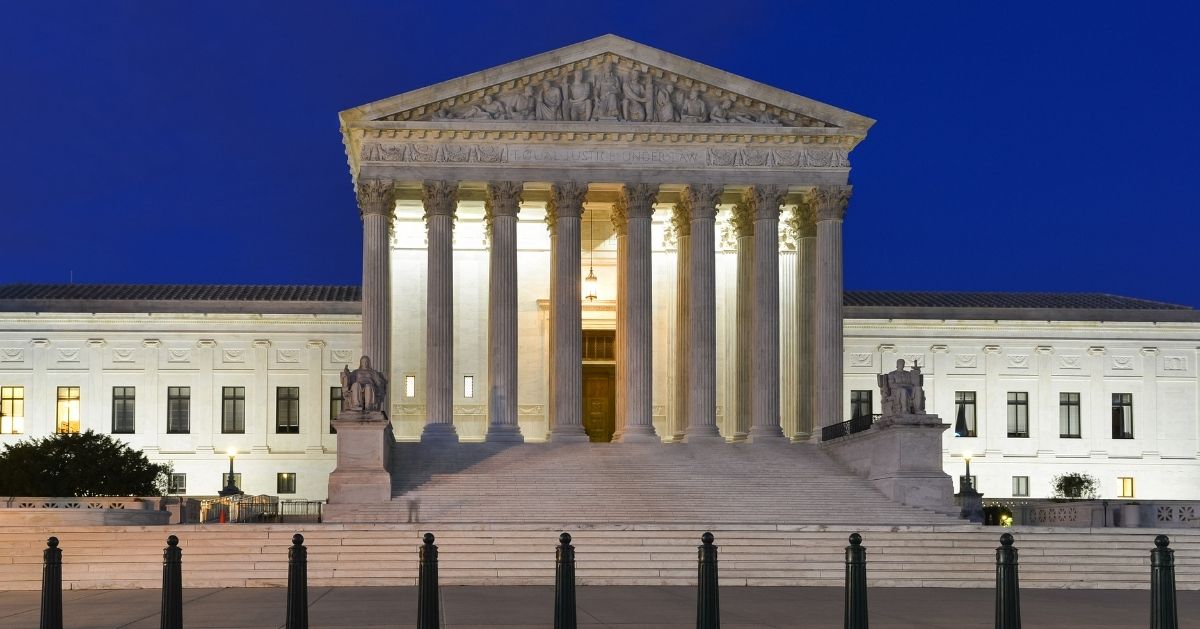
The Supreme Court's decision to strike down his sweeping worldwide tax earlier in the day added a domestic frustration to a presidency already operating on multiple fronts simultaneously. But foreign policy is where executive power is least constrained by judicial interference, and the Iran portfolio reflects a commander-in-chief using every tool available to him.
A State Department insider told the Daily Mail that Trump is weighing advice from his cabinet and mulling options on military action. The president, the insider indicated, would provide the "green light" for actions in Iran.
Iran's leadership faces a straightforward calculation. Negotiate seriously and abandon the nuclear ambitions that have destabilized the Middle East for two decades. Or watch the largest concentration of American military power since last year's 12-day conflict continue to build on every horizon.
The carrier groups aren't coming home empty-handed. Either they come home with a deal, or they don't come home soon.